You may know how to say I love you in Japanese…. Everyone likes to hear that!
Now, how about phrases you don’t want to hear in Japanese?
Like, how to say “I hate you” in Japanese?
Warning — Japanese people generally don’t say “I hate you.”
(Which means you’re here because you don’t understand Japanese culture and just want to know how to say this anyway.)
In Japanese culture, it is valued to keep your feelings inside rather than confront others.
You would almost never say this directly to someone. Even if you want to say it, you’ll likely use different kinds of language to imply you hate them without saying it directly.
Having said that, here are 12 ways to say I hate you in Japanese.
By the way, if you want 30+ FREE Japanese PDF Lessons, click the button below.
1. Anata ga kirai
- あなたが嫌い
- Anata ga kirai
- I hate you
The most literal translation of “I hate you” in Japanese is anata ga kirai. Kirai in Japanese means to dislike or hate.
Again, you’ll never really hear this in real life… but if you wanted to know the literal phrase, this is it.
Send this to someone 😉

2. Daikirai
- 大嫌い
- Daikirai
- I really hate you
If you want to make the phrase even stronger, you can use the word dai in front of it, which means “very” or “really.”

This can be blunt and harsh and, in some ways, childish.
You’ll mostly hear children saying this about things or even to their parents. This would be too confrontational and impolite to use in a polite context. And you’re not a child, are you?
3. Mou kirai
- もう嫌い
- Mou kirai
- I’ve had enough, I hate you
When you strongly dislike someone and can’t handle them anymore, you can add mou to the phrase “I hate you”.

It can express frustration, especially if you’ve given the other person a chance, and they are still acting badly towards you.
This is not something you should use in polite contexts, but it could be more conversational than other phrases of dislike. You can also use this phrase towards situations, places, and objects.
4. Uzai
- うざい
- Uzai
- Annoying/Irritating
Another way to express hate without saying it directly is to say it is annoying or irritating — which is what uzai means.

Uzai is slang and casual word that you’ll often hear in anime, manga, and spoken by younger adults and teens.
For example, if a teenager’s mom keeps pestering them to do homework, the teenager might tell the mom that she is uzai. It shouldn’t be used in professional settings as the way of speech can sound childish.
5. Suki ja nai
- 好きじゃない
- Suki ja nai
- I dislike you.
This is a mild version of “I hate you” so that it is softened into “I dislike you.”
Although it is possible to say this, it usually doesn’t get used towards other people, and there are not too many contexts where this would be applicable.

For example, if someone tells you that they like you romantically, you might say this back if you don’t feel the same way.
The more common use of sukijanai is if you have a situation where you want to express dislike towards things, situations, and experiences.
6. Nigate
- 苦手
- Nigate
- I’m not good with you
Instead of saying that you hate someone, you can say that you’re not good with someone or you are not able to handle them.

Nigate in Japanese means “not good” in terms of ability or handling things… and can be applied to people, foods, and activities.
You can be nigate at tennis or video games (meaning, you’re just not good at playing.) Or you can be nigate with spicy food… meaning you’re weak and can’t handle it.
Instead of putting the hate towards the other person, you say that you’re not good with the other person.
For example…
- 彼が苦手です。
- kare ga nigate desu)
- meaning: “I can’t deal with him very well.”
If you have a co-worker that you don’t get along with or don’t have the same views, this could be applicable.
7. Urusai
- うるさい
- Urusai
- Annoying/Irritating/Noisy
Similar to uzai, urusai is a more formal way to say the same thing.
Although it literally means “noisy” it can express annoyance and hate.

If someone keeps telling you to clean your room, you can say urusai as a way to say that they are annoying or irritating.
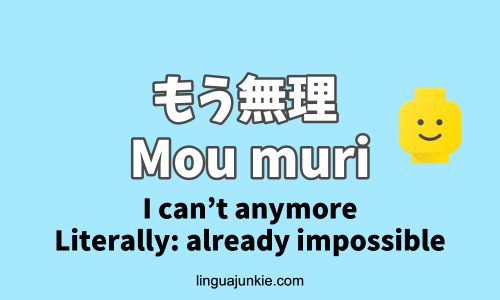
8. Mou muri
- もう無理
- Mou muri
- I can’t anymore
- Literally: already impossible
When you hate someone, you might not want to associate with the other person anymore.
This could be used in a romantic context if a partner cheated and you tell them that “you can’t anymore,” meaning that the relationship is over.
This could be a relevant phrase for expressing hatred or dislike.
9. Seikaku ga kirai
- 性格が嫌い
- Seikaku ga kirai
- I hate your personality
Instead of directly saying you hate someone, it could make more sense if you choose a certain aspect of the person that you don’t like.
In this case, seikaku ga kirai, means that you hate the other person’s personality.

When expressing hate or dislike towards others, this could also help to convey the right feelings and emotions.
10. Kimochi warui
- 気持ち悪い
- Kimochi warui
- Disgusting
If the hate is really strong, it might be so much that you feel that they are disgusting.
Kimochiwarui can be used in extreme cases when you feel like the other person is disgusting or gross.

However, this is a strong thing to say, so it would be recommended to only use this if someone has really crossed your boundaries and done something bad to you.
11. Kimoi
- きもい
- Kimoi
- Disgusting
This is a slang word for disgusting, and is a shortened version of kimochiwarui.

Younger adults and teenagers might use this to express dislike and hate towards people.
For example, if there is a person who seems to be stalking you, you could say that they are kimoi. In regular day-to-day conversations, you most likely shouldn’t use this phrase as it sounds impolite and childish.
12. Aitakunai
- 会いたくない。
- Aitakunai
- I don’t want to meet you
If you strongly dislike someone, you might not want to meet them anymore.
This phrase can be used if you are ready to cut your ties with that person.

If your relationship is not repairable anymore, you could say this phrase.
Be mindful that this is a strong phrase and that you’re sure you are ready to end your relationship with them.
Bonus PDF
By the way, if you want to master some of these phrases for good…
Check out this Japanese PDF lesson. Save it. Print it. Review it.
And you’ll be speaking Japanese in no time.
Back to You
Now you know how to say I hate you in Japanese.
But remember, almost nobody says it directly.
Speaking of hate…
Wouldn’t you hate it if you didn’t learn and speak real Japanese?
For that, you’d want a good Japanese learning program…
I recommend JapanesePod101 for their conversation-based lessons. Unlike other apps like Duolingo, you’re not playing word games… instead you’re listening to real native speakers having conversations… and then the teachers in the lesson explain every word so that you understand it and start speaking Japanese yourself.
Anyway, if you have any questions…
Leave a comment!
The Main Lingua Junkie

Related lessons: