Want to know some good Japanese summer words?
Well, good!
This post is all about 夏の言葉 (natsu no kotoba – summer words),
By the way, what’s natsu? Great question, glad I asked myself… since you’re not asking but reading.
 Want to learn how to read and write Japanese? Download your free Japanese Hiragana/Katakana (Alphabet) worksheet here.
 1. Natsu 夏
- Meaning: Summer
Natsu (なつ) is how you say summer in Japanese.
In Japan, summer starts off with the rainy season which takes up some, if not most, of June… where it’s mostly cool and wet. Immediately after, it’s as if a switch was flipped, the sun comes out and the temperature and humidity shoot up.

2. Natsumeku 夏めく
(なつめく)
- Meaning: to start to feel like summer
Ever feel like, “ah, it’s starting to feel like summer?”
Whether if it’s the air getting warmer, people dressing in shorts and tank tops, or more barbecues….

Yep, that’s where this word comes in. Natsumeku is a verb that essentially means “it’s starting to feel like summer.” It’s a combo of the word “natsu” and “meku” which is a verb suffix that adds the meaning “to become like” or “to show signs of,”
You could use it with spring as well…
- 春めく (harumeku) – to become spring-like
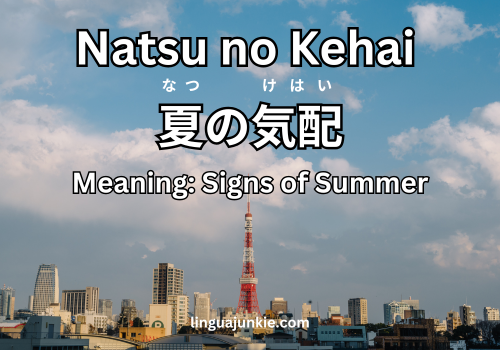
3. Natsu no Kehai 夏の気配
- Meaning: Signs of Summer
Kehai is a new word here. It means “hint” or “indication.”
So, when you feel that warmth in the air despite, flowers blooming, and the little signs that Summer’s on the way… That’ a “natsu no kehai.” A sign of summer. Unlike natsumeku, which is a verb, this is a noun-phrase.
4. Natsubate 夏バテ
- Meaning: Summer fatigue
Natsubate’s a condition you’ll get when it’s just too dang hot and humid. You may feel weak, lose your appetite, or have trouble sleeping. It’s not exactly a sickness, but just a “bleh” feeling that makes daily life harder.
Cold summer drinks like pocari sweat, naps, and light meals help fight it off.

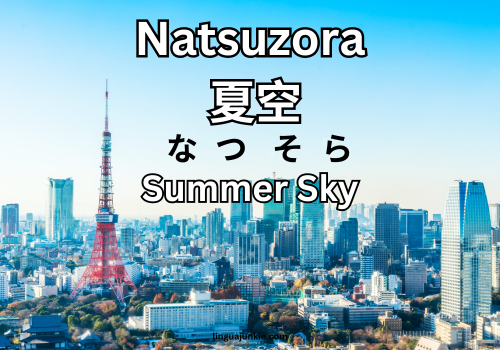
5. Natsuzora 夏空
- Meaning: Summer Sky
This word is a combo of the Kanji for summer and sky (sora).
And it refers to the bright blue summer sky, often with big white clouds. The kind you’ll see in the horizon with rice fields, mountains, and small towns, as you ride by on the Shinkansen.
6. Hanabi 花火
- Meaning: Fireworks
- Literally: flower of fire / fire flower
You’ll find Hanabi on my list of beautiful Japanese words.
And it’s also a Japanese summer word! Japanese summers are known for fireworks displays.

Interestingly, this word is a combination of the Kanji for fire 火 and the Kanji for flower 花 – literally fireflower.
These fireworks displays are called…
7. Hanabi Taikai 花火大会
- Meaning: Fireworks festival
Basically, huge festivals that the whole town or city shows up for to enjoy together. Where people wear yukata, bring snacks, and watch with their friends and family within their local city or community.

8. Yukata 浴衣
- Meaning: A summer kimono
A yukata’s basically a light, summer Kimono that people will wear to summer festivals… like hanabi taikai and bon odori. Yukata come in all kinds of colorful designs – flowers, waves, fireworks and so on.

9. Bon Odori 盆踊り
- Meaning: Obon dance
Bon Odori is a traditional dance you’ll see during Obon. Obon’s a summer holiday to honor ancestors. Communities will gather in open spaces, wearing yukata, and dance in a circle to taiko drums and folk songs.

Just another event that makes Japanese summers special.
Speaking of festivals…
10. Matsuri 祭り
- Meaning: Festival
A “Matsuri” is a traditional Japanese festival, often tied to local shrines, seasons, or cultural events. Streets fill with food stalls, music, games, and people in yukata. Some feature parades with floats called mikoshi.
There are also Obon festivals, which include Bon Odori dances. These are also considered a type of matsuri.

If you want to be specific about festivals…
The kind that happen in the summer, then here’s good word to know…
- 夏祭り (natsu matsuri) – Summer festival
11. Kakigoori かき氷
- Meaning: Shaved ice with flavored syrup
A Kakigoori is a Japanese summer treat… shaved ice topped with sweet syrup. There are flavors like strawberry, melon, and matcha.

You’ll find it at festivals, convenience stores, and specialty shops.
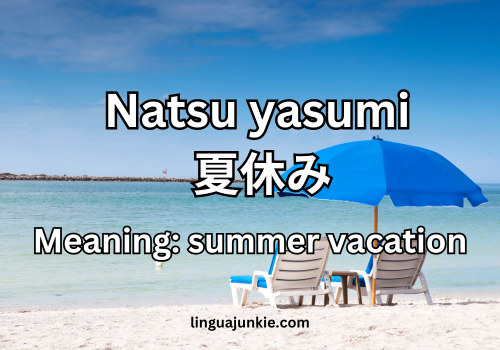
12. Natsu yasumi 夏休み
- Meaning: summer vacation
Natsu yasumi means “summer vacation,” especially for students, lasting from late July to late August. Adults don’t usually get a long break, but many take a few days off in mid-August during Obon, a national holiday period.
13. Yuudachi 夕立
- Meaning: A sudden summer rain shower
夕立 literally means “evening burst” or “evening onset”, referring to a sudden rain shower that starts in the evening.

Yuudachi refers to a sudden, heavy rain shower that happens in the late afternoon or early evening during summer. It comes on quickly, pours hard, and ends just as fast.
14. Mushiatsui 蒸し暑い
- Meaning: humid (adjective)
This adjective means hot and humid… and what you’d use to describe the sticky, sweaty kind of heat that makes clothes cling and air feel heavy. Common in Japanese summers, especially after the rainy season.
15. Shikke 湿気
- Meaning: humidity (noun)
This is the word for humidity – as a noun. humidity or moisture in the air. You’ll get a lot of shikke during Japanese summers.
16. Tsuyu 梅雨
- Meaning: Rainy season
Right before you actually get to the heat and humidity…
There’s Tsuyu. Tsuyu is Japan’s rainy season and usually lasts from June to July.

It doesn’t rain all the time… but it’s often cloudy, damp, and muggy. But not hot. The moment Tsuyu is over, full-blown summer kicks off like someone flipped a siwtch.
17. Atsui 暑い
- Meaning: Hot (adjective)
Atsui is an い-adjective for “hot” when talking about weather or air temperature…. and a good Japanese weather word to know! You’ll hear it a lot in the summer!

One good phrase to know is…
- 暑いですね。
- Atsui desu ne.
- It’s hot, huh?
If you want to talk about today…
- 今日は暑いですね。
- Kyō wa atsui desu ne.
- It’s hot today, isn’t it?
Or, if it’s been getting hotter…
- 暑くなってきましたね。
- Atsuku natte kimashita ne.
- It’s getting hot, isn’t it?
Talking about weather is always good for small talk… and I include similar phrases in my post for Japanese small talk phrases.
18. Mousho 猛暑
- Meaning: Extreme heat / Heat wave (Noun)
猛暑 is “intense heat” or “scorching heat,” Meaning, extremely hot weather during summer. You’ll hear it in weather forecasts, news reports, and daily conversation to describe dangerously hot conditions that can affect your health and daily life.

You’ll often see it in phrases like 猛暑日 (moushobi), which refers to days when temperatures reach 35°C (95°F) or higher.
- 猛暑日
- moushobi
- Day over 35°C (95°F)
19. Kaisei 快晴
- Meaning: clear sky
快晴 (kaisei) means “clear weather” or “fine weather.” It describes cloudless, sunny skies with excellent visibility. Used in weather forecasts, news reports, and everyday conversation to describe perfect weather… which often happens during summer.

20. Semi 蝉
- Meaning: Cicada
No Japanese summer is complete without semi (せみ) buzzing. You may have heard ’em in anime or drama scenes… but it’s all true.
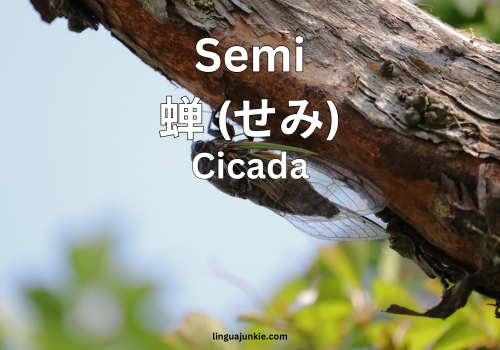
These guys get buzzing when the heat starts and are a symbol of the Japanese summer.
21. Hotaru 蛍
- Meaning: firefly
Fireflies are most active during the summer months… and as such, are associated with summer. In fact, hotaru-viewing is a summer tradition in Japan.

22. Ajisai あじさい / 紫陽花
- Meaning: Hydrangea
“Hydrangea” are the large, colorful clusters of flowers. You’ll see them during Japan’s rainy season (tsuyu) in early summer… between June and July. Colors vary from blue and purple to pink and white.

You’ll often see them around temples, shrines and parks.
23. Umi 海
- Meaning: ocean / sea
While this is not JUST a summer word, “umi” IS strongly associated with summer…
You know, since everyone goes to the beach and or on seaside vacations during the hot months.

24. Suzukaze 涼風
- Meaning: cool breeze / refreshing wind
In other words, a pleasant, cool breeze that provides relief from summer heat. Suzukaze is commonly found in poetry, literature, and everyday conversation when describing pleasant weather conditions.

25. Ryokuin 緑陰
- Meaning: green shade / shade under green leaves
In other words… the cool, refreshing shade created by green foliage during summer.

This word commonly used in literature and poetry to describe peaceful, cool spots beneath trees. So, don’t expect to hear this in everyday life… but it is indeed a beautiful Japanese to know.
26. Fuurin 風鈴
- Meaning: Wind chime
Fuurin are small bells or chimes hung outside during summer… and make gentle tinkling sounds when moved by the breeze.

In Japanese culture, fuurin are believed to create a psychological cooling effect – the sound is associated with coolness and helps people feel refreshed during hot weather. You’ll see them hung from eaves, balconies, or in gardens as both decoration and a way to “hear” the breeze… or suzukaze.
27. Asanagi 朝凪
- Meaning: morning calm over the ocean
(あさなぎ)
This is a phenomenon that you’ll see on summer mornings… where there’s no wind and the waves are calm, if not down to zero

How does this happen? Why in the summer mornings? Well, in the early mornings, the temperature on land and on sea is about equal (because the land cools at night and cools down to the temperature of the sea)… which results in no wind.
This is a very brief period but also a very calm and peaceful one.
28. Natsu no owari 夏の終わり

This list of Japanese summer words won’t be complete without this phrase.
Because all good things come to an end.
夏 (natsu) means “summer,” as you already know. の (no) connects words like “of,” and 終わり (owari) means “end.”
29. Natsu yasumi dou deshita ka?
- 夏休みはどうでしたか?
You already know what natsu and yasumi mean.
It’s just a matter of adding “dou” (how) and “deshita” (past tense of was).

For a more casual way to say it, we just change “deshita” to “datta.” In Japan, chances are it’ll be kids using this phrase rather than adults… since summer vacations are for students and adults don’t exactly get summer vacations. So, they’ll be using the casual way.
- 夏休みはどうだった?
- Natsu yasumi dou datta?
Back to You!
Now you know some cool Japanese summer words.
You can also watch the video on YouTube
Which one was your favorite?
Leave a comment.
I read ’em all.
You may also be interested in these other words…
The Main Lingua Junkeh