Hey!
In this guide, you’ll pick up 14+ Japanese words and phrases for peace.
1. Heiwa
- 平和
- Peace
Heiwa is one of the most essential words for peace in Japanese.
The two kanji characters that make up this word are 平 (hei), which means flat, calm, or peaceful, and 和 (wa), which is all about harmony.

Together, it represents peace from the standpoint of society and ideology.
After WWII, this has been an especially important word for Japan, which is now known as one of the most peaceful countries in the world.
Now, if you want your peace and quiet in Japanese…
You can say…
2. Shizuka ni Shite Kudasai
- しずかにしてください
- Please be quiet
This is a polite way to ask somebody to be quiet in Japanese.
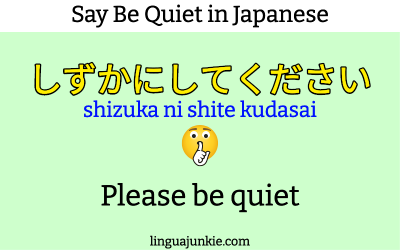
The literal translation is “Please be quiet”. The word しずか (Shizuka) means “quiet”, and してください (shite kudasai) means “please do”.
If you want more ways to demand your peace. (including some rude ones)..
…check out Say Shut up in Japanese.
3. Wa
- 和
- Harmony
Another important word for peace in Japanese is wa…
And you’ll find it on my list of beautiful Japanese words.

This word symbolizes harmony and balance. It also represents the way that individuals put the group ahead of their personal interests.
Wa has also been a word that is used to represent Japan itself.
For example, washoku means Japanese food and wagashi means traditional Japanese sweets.
In Japanese culture, putting the group interests above the personal ones is what creates a harmonious society with low levels of conflict.
4. Shizukesa
- 静けさ
- Quiet peacefulness
This word conveys peace through tranquility and quietness.
It has a poetic nuance where the quietness is not just about the sound volume, but the feeling you get from the environment.
For Japanese people, shizukesa can also evoke feelings of reflection and emotional serenity.
You can find shizukesa during Japanese tea ceremonies, and when walking around zen gardens.
Note on language: Shizuka is the adjective for quiet, and when you add a “sa” to an adjective, it’s like adding “ness” to it.
5. Anshin
- 安心
- Relieved or at peace
Anshin represents a feeling of inner peace and safety.
The two kanji characters that make up this word are 安 (an), which means safe or calm, and 心 (shin), which means heart.

When translated literally, it could mean “peaceful heart”.
The peace that you feel from anshin is feeling secure and knowing that nothing bad will happen.
You might feel anshin, or a sense of peace, after installing a security alarm in your house.
6. Heion
- 平穏
- Tranquility
If you’d like to describe a situation where you feel peace and calm in your environment and mental state, you could use heion.
This word uses the two kanji characters 平 (hei), which means flat or calm, and 穏 (on), which means gentle or mild.
When they are combined, they represent a tranquility about your surroundings and daily life.
Compared to heiwa, which uses similar characters, it is more about your personal and situational life rather than peace on a global and societal scale.
7. Hitoiki tsuku
- 一息つく
- Taking a breath
This is a symbolic word in Japanese for peace because it represents the way that you can take one breath to feel at peace.
Hitoiki tsuku is similar to “catching a breath” in English.
You’d use this phrase when you’ve been extremely busy and finally get a moment to rest or take a short vacation.
8. Buji
- 無事
- To be safe
Buji is a word that also relates to peace because feelings of safety contribute to having a sense of peace.
In Japan, not having any incidents and things working as intended are important in its culture.
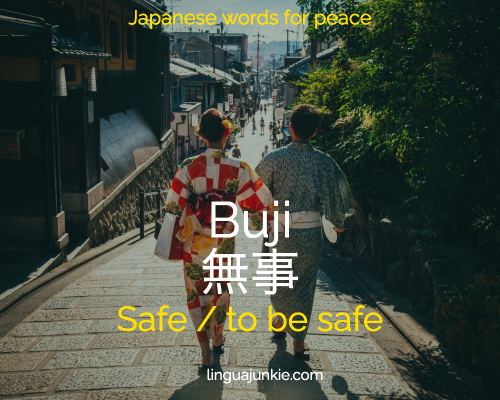
For example, Japanese trains are famous for being exactly on time to the exact minute.
When the train arrives as planned, someone might say buji ni tsuita, meaning “I arrived without any incidents”.
9. Odayaka
- 穏やか
- Calm
This is a Japanese word that describes things, situations, and people that are calm or peaceful.
For example, if the oceans have no waves, you can say it is odayaka.
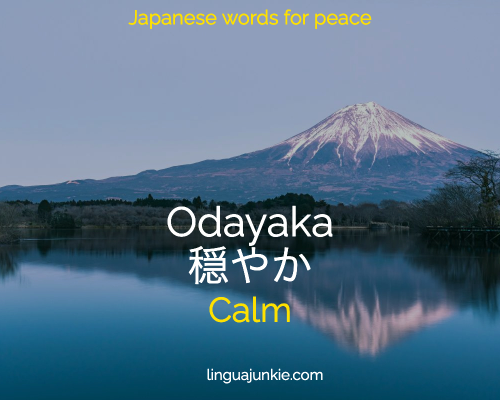
Another interesting use case of this word is that you can use it to describe people.
Someone who is odayaka is calm and rarely gets into arguments or becomes violent.
In Japan, this kind of personality trait is thought of highly.
10. Reisei
- 冷静
- Composed and cool-headed
If you’re in a dangerous situation, it is important to be reisei, or cool-headed and composed.
This word describes staying calm in high-pressure and intense situations.
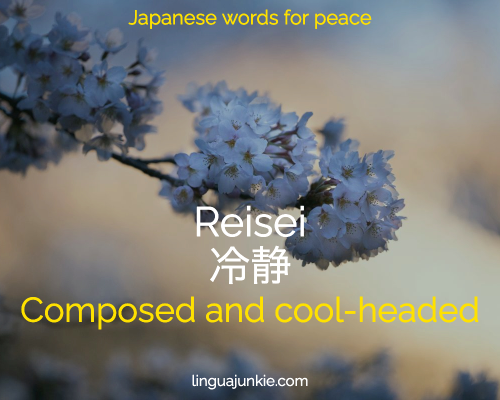
It’s easy to panic in emergencies, but the best outcomes of an emergency are usually from not panicking.
Someone who is reisei has an inner calm and peace to be able to set aside those feelings of panic and look at the situation at hand in a calm and collected way.
11. Heiwa shugi
- 平和主義Heiwa shugi
- Pacifism
Heiwa shugi represents peace as an ideology and policy.
It involves a deep commitment to peace and nonviolence.
For Japan, heiwa shugi is especially significant. After WWII, they have renounced war and limited the military to act only as a defense force.
12. Kokoro ga nagomu
- 心が和む
- Emotionally at ease
This is an expression that means that you are at ease and soothed.
In Japanese, 心(kokoro) means heart, and 和む (nagomu) means to soften or calm down.
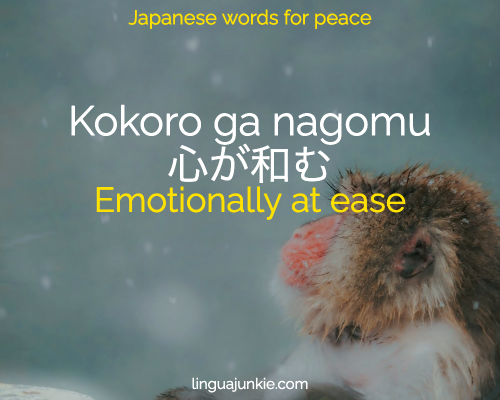
It is a feeling you get when you see cute animals or feel soothed by walking in a beautiful park in nature.
Unlike other words for peace, this is something that happens in a distinct moment that makes you feel at peace, and your worries melt away.
13. Kokoro no heiwa
- 心の平和
- Inner peace / peace of mind
You’d use this phrase when you’re at peace with oneself and the world. It’s a concept valued in Japanese culture and many Eastern philosophical traditions, particularly in Buddhism and mindfulness practices.
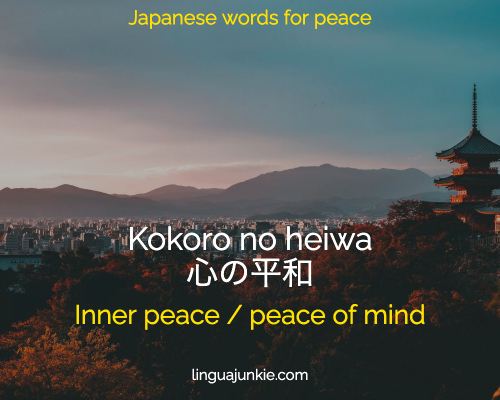
Achieving 心の平和 often involves letting go of anxieties, accepting things, and finding balance in one’s thoughts and emotions.
In everyday context, people might seek 心の平和 to deal with stress, conflict, or turmoil in their lives.
14. Antai
- 安泰
- Lasting peace
Antai is a sense of long-lasting peace, stability, and security.
安 (an) means peaceful or safe, and 泰 (tai) means calm and stability.
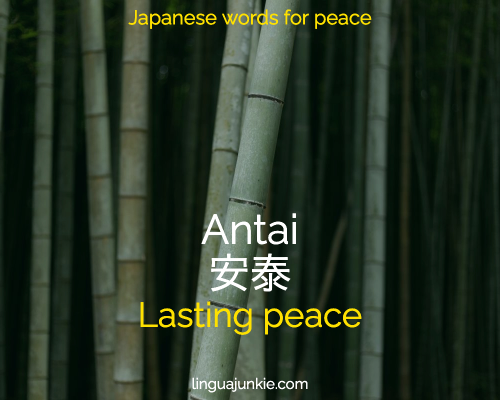
When combined, it means that everything is steady and secure.
It is usually used in a more formal context, such as wishing antai for an entire country, or if you secure a tenure position job, then you could be financially antai.
15. Piisu
- ピース
- Peace
In Japan, you can also use the English word for peace in Japanese…
…and here, it’s just peace written in Katakana (the writing system used for foreign words).
It is very casual and gives a hip vibe compared to traditional Japanese words for peace.
Although it could work in a conversation as meaning peace, it is most widely used among Japanese people to symbolize the “peace sign,” which they use when posing for pictures.
So, if you want to say peace sign in Japanese, it’s the following in Katakana.
- ピースサイン
- pi-su sain
Saying Peace / Bye in Japanese
Finally, you may wanna to know…
How does one say “peace” like the “peace” in English, where you’re saying bye?
Well, for that, there’s no same usage of peace, so you may as well use….
- Bye/See ya
- Ja ne
- じゃね
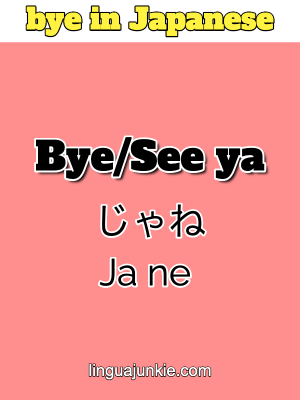
You can learn more here in my other lesson — Say Bye in Japanese.
Back to You
Now you know the most common Japanese words for peace.
Which was your favorite?
Leave a comment, I read ’em all.
The Main Lingua Junkie