So, look…
The most common way to say “delicious” in Japanese is oishii (おいしい).
But Japanese has several words for delicious… which you should know.
It’ll make you sound smarter, natural and sexier…
So, keep on reading. There’s also audio pronunciation and free PDF lessons you can download.
Quick Reference:
| Japanese | Reading | Hear it | Meaning / Usage |
|---|---|---|---|
| おいしい / 美味しい | oishii | Delicious (polite, universal) | |
| うまい / 旨い | umai | Delicious / tasty (casual, masculine) | |
| めちゃくちゃうまい | mecchakucha umai | Incredibly delicious (very casual slang) | |
| 絶品 | zeppin | Exquisite, superb (dish) (high praise) |

Oishii (おいしい)
Oishii (おいしい / 美味しい) is the word for “delicious” in Japanese.
You can use it in every situation…
Whether you’re complimenting a home-cooked meal, food at a restaurant, or while eating Japanese street food.
How do you pronounce oishii?
Well, if you’ve listened to the audio above… here it is again.
You say it as three syllables: o – i – shi.
That final “ii” is a long “ee” sound and is held slightly longer than you’d expect.
Say it with me: “Oh-ee-shee.”
Kind of sounds like “how is she?” “o-ee-shee”
Now, here are some ways you can use this word and sound like a capable Japanese speaker.
Oishii!
- おいしい!
- Delicious!
Yes, you can literally blurt out one word…
And still sound like you’re a sane and intelligent adult.
I know, weird in English, but it works in Japanese.
Kore wa oishii desu.
- これはおいしいです。
- This is delicious.” (polite)
“Kore” means “this.”
“Wa” is a Japanese particle that marks the subject of the sentence (kore – this.)
We all know what oishii is (if you still don’t, may the lawd have mercy.)
Oh and desu… consider that as “is” for now. I explain the Japanese desu meaning here.
Totemo oishikatta!
- とてもおいしかった!
- “That was so delicious!” (past tense)
“Totemo” is “very.”
“Oishikatta” is delicious in past tense.
Easy enough, eh?
Umai (うまい)

Umai (うまい / 旨い) is the second most common word for delicious.
However…
It’s somewhat masculine, if that doesn’t bother you.
You’ll hear it constantly among friends, in anime, and at izakayas (Japanese pubs).
How to pronounce umai:
Look, it’s not that hard.
It’s two syllables: u + mai.
Say “oo.. my.” Here, listen to it again, will ya?
A note on meaning: Umai also means “skilled” or “good at something,” so context matters.
Here are some ways you can use this word.
Umai!
- うまい!
- “Delicious!” (casual, enthusiastic)
Yep, the good old blurting out one word.
Just say the word by itself.
But if you want to speak in full sentences like an adult…
Kono ramen, chou umai.
- このラーメン、超うまい。
- “This ramen is super delicious.” (very casual)
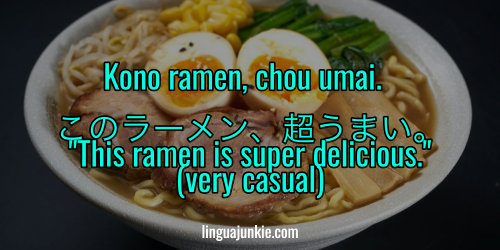
“Kono” means “this.”
“Ramen” means… well, do I have to explain it?
And “chou” is a casual way to say “very.”
ishii vs. Umai
Now, let’s compare these two common words.
Use oishii when you’re:
- Speaking to anyone you don’t know well
- Talking to an elder, a host, or in a restaurant setting
- Writing a review or caption
- Unsure which word fits
Use umai when you’re:
- With close friends or family
- In a casual izakaya or ramen shop vibe
- Going for an authentic, unfiltered reaction
Easy enough, eh?
Extra Ways to Say Delicious in Japanese
Look, oishii and umai are pretty much all you need.
But if you want to be a bit smarter…
These expressions will help you sound more… interesting.
Meccha umai or Cho umai (めっちゃうまい / 超うまい)
Slang intensifiers meaning “incredibly delicious.” Meccha (めっちゃ) comes from Osaka dialect and is widely used by younger speakers. Chou (超) means “super.” Both are very casual.
Zeppin (絶品)
Zeppin means “exquisite” or “exceptional dish.”
This word is a step above regular dinky compliments.
You’d use it to describe something genuinely outstanding… like a kaiseki course, an artisanal ramen, a perfectly crafted wagyu dish.
Zeppin is the food equivalent of calling something a masterpiece.
Bimi (美味)
A more literary and old-fashioned term for “delicious flavor.” You’ll mostly see this in written menus, food journalism, or formal contexts rather than everyday speech.
Kuchi ni au (口に合う)
Literally, this phrase means “suits my mouth.”
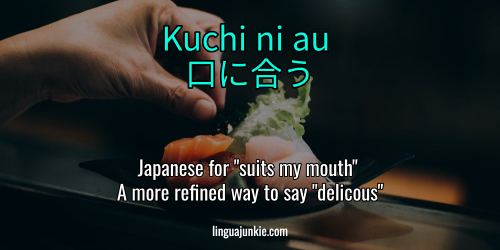
But what it means is “it agrees with my palate.”
Just a more refined, considerate way to compliment food, often used when eating at someone’s home.
How to Compliment Food Like a Native Speaker
Saying delicious is just one way to compliment food.
Japan loves their food…
…and complimenting food is a good social gesture.
So there are some extra food phrases you can use.
Itadakimasu (いただきます)
You say this before eating.
It literally means “I will receive” but this saying expresses gratitude for the meal.
Not “delicious,” but essential food vocabulary.
Gochisousama deshita (ごちそうさまでした)
You say this after eating as thanks the host or cook.
So, say it as you’re leaving a restaurant.
The implied meaning of “gochisou sama deshita” is “that was a wonderful meal.”
You can read my guide on itadakimasu vs gochisousama here.
Oishisou! (おいしそう!)
Which means… “That looks delicious!”
The ~sou suffix means “looks like / seems like,” used before tasting.
You can use that as you’re admiring and getting ready to chomp down.
How to Say “Not Delicious” in Japanese
Look, it’s possible not everything will be oishii.
Like natto (learn more about it at the link).

Here’s how to say so without causing a diplomatic incident…
But before you learn some unsavory words…
Criticizing food can feel rude, especially when someone has cooked for you. And in most cases, native speakers will not say it out right. Instead they default to vague softeners like chotto… (ちょっと… — “it’s a little…”) and trail off, leaving the negative implied rather than stated.
So, if you want to sound like a competent speaker who’s also aware of the culture… keep that in mind.
Having said that…
Mazui (まずい)
Mazui is an adjective.
It means gross, tastes bad, or just plain awful.
You probably don’t want to say this to someone who just cooked for you, but with close friends it flies just fine.
- Mazui!
- That’s nasty!
Oishikunai (おいしくない)
This is the polite way to say “not delicious” and the negative form of “oishii.”
It’s way softer than mazui and much less likely to hurt anyone’s feelings.
- Chotto oishikunai desu ne.
- It’s not really delicious, eh?
Kuchi ni awanai (口に合わない)
Literally meaning,“It doesn’t match my mouth.”
This is the most natural and polite way to say something isn’t to your taste… or “not for me.”
For example…
- これはちょっと口に合わないです。
- kore wa chotto kuchi ni awanai desu.
- This isn’t really for me.
Amari suki ja nai (あまり好きじゃない)
This translates to “I don’t really like it.”
You’re not saying it’s NOT delicious. Just that you generally don’t like this kind of food. Smart move because it’s about your preference, not the food itself… so nobody has to take a punch to their culinary face.
Extra (Free) Stuff for You
So, since you’re here and all..
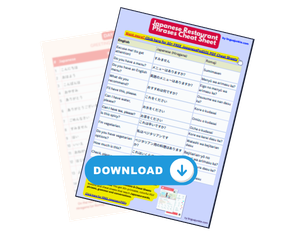
I’ll give you a free cheat sheet covering Japanese food and restaurant phrases.
You’ll find it on my Japanese Cheat Sheets page, so click the image below.
Frequently Asked Questions
What’s the best way to say delicious in Japanese? It’s Oishii (おいしい).
What is the difference between oishii and umai? Both mean delicious, but oishii is polite and neutral and umai is casual and sounds masculine.
How do you pronounce oishii? Say it like this: “oh-ee-shee.”
How do you say “this is delicious” in Japanese? Kore wa oishii desu. (これはおいしいです。)
How do you say “that was delicious” in Japanese? Oishikatta! (おいしかった!) This is the past tense of oishii. You”d say that after finishing a meal.
What do Japanese people say before and after eating? Before eating: Itadakimasu (いただきます). After eating: Gochisōsama deshita (ごちそうさまでした). Neither means “delicious,” but both are essential food phrases and skipping them can come across as rude.
Is it rude to say food is not delicious in Japanese? Yes, directly saying mazui (まずい) to someone who cooked for you is rude. When in doubt, a vague chotto… and a trail-off does the job politely.
Can you use oishii before eating? Well, how would you know it’s delicious if you didn’t eat it, Jack? Just say oishisou (おいしそう!), which means “that looks delicious!”
Back to You
So, now we turn to you.
Now, I need you to tell me what was delicious.
And use the words you learned here, okay?
Leave a comment.
– The Main Lingua Junks
konnichiwa watashi no namae wa Anastia [ hello my name is anastaisa