What does desu mean?
Because it’s everywhere in Japanese… isn’t it?
It’s the period at the end of sentences, the root of Japanese politeness, and possibly THE most common Japanese word.
You’ve heard it thousands of times… and wondered about it. Well, here’s the thing: です is way more complex than anyone tells you.
…and I’m going to tell you now. Are you ready to get told?
Good. Let’s dive into the meaning of desu.

What is です (desu) Really?
です (desu) is a copula.
The end. Now you know.
“Wait, it’s a whattt???”
I know, I know. That didn’t help me either when I first heard the word.
So, a copula is just a fancy shmancy grammar word that means “linking word.” A word that links subjects with descriptions, states of being, or identity. But calling it just a copula is like calling sushi just “fish and rice.” While it’s true, there’s more to it.
You’ll often see です translated as “is,” though it’s not exactly the same thing.
Desu is more like a verbal bow. A gesture that packages your statement in polite wrapping paper before handing it to your listener.
At its core, です does 3 things…
Thing #1 – It’s declaration maker – “X is Y”
Think of です as the equal sign in Japanese. It connects a subject to what it is. This is the most basic function:
- 猫です。
- Neko desu.
- It’s a cat.
Here, です says: “The subject = cat.”
Without です, the sentence feels blunt or unfinished. Like you blurting out the word “cat” in English… without saying anything else. Someone will think… “cat? what about the cat? What a weird guy. Speak in full sentences, please.”
With です, the statement is neatly packaged as a declaration.
Thing #2 – Politeness marker – Makes things formal & respectful
So, です doesn’t mean “please” or “thank you,” but adding it on makes your sentence polite. In general, longer statements are more polite. The longer, the politer in Japanese… but that’s a topic for another time.
です softens your tone and shows respect to the listener.
- 猫です。Neko desu. → Polite.
- 猫だ。 Neko da. → Plain, casual, sometimes rough.
So, same meaning (“It’s a cat”), but です raises the formality level.
It’s why beginners are taught to end sentences with で… because it’s safe and respectful in pretty much all situations. Unless you want to sound like a kid.
Thing #3 – Sentence finisher – “I’m done talking, your turn”
です also signals that you’re done talkin’ and handing the microphone to the other person.
In Japanese, sentences often don’t need a subject (like “I” or “you”), so です acts as a neat period at the end.
- 寒いです。
- Samui desu.
- It’s cold.
You don’t have to say “I’m cold” or “The weather is cold.” Just “Cold + desu” is enough. です wraps up the thought politely and clearly… as bowtie on a gift box.
By the way… if you want a free PDF cheat sheet to review the desu, click here.
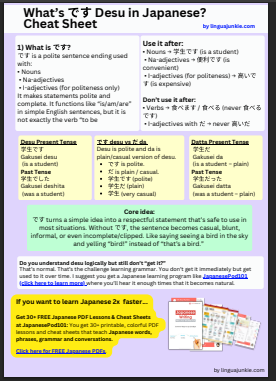
Desu Pronunciation: “Desu” or “Des?”
Here’s the first thing that trips beginners up…
です is written as “de-su” so beginners say it as “desooo0o0o.”
Remember this for good… “desu” is pronounced as “des” (like “desk” without the “k”).
This isn’t just random.
This “U” droppage is a systematic sound change you’ll see across Japanese. The same thing occurs with ます (masu → mas) and other verb endings. Native speakers aren’t “dropping” the sound; their brains literally don’t register it as there anymore.
You’ll only hear native speakers say desu with the “u” included in formal speeches, news, songs, or when they’re speaking slowly and clearly for emphasis.
Quick fact: Some Japanese people are actually surprised when foreigners pronounce it “de-su” because it sounds overly formal and artificial to their ears… like pronouncing the “t” in “often” in English, when you’re not British.
Desu Grammar Explained
Now, if you care about the intricacies of grammar, I guess I’ll satisfy your fancy.
The Most Basic Pattern
You’ll often see “desu” in some variation of the X wa Y desu pattern.
Where you say “X is Y.”
Essentially, any line where the second to last word is a noun or an adjective. Think of phrases like “I am a student,” “This is green,” You are happy,” and “Today is Monday.”
Here are some Japanese examples…
- 私は学生です。
- Watashi wa gakusei desu. “I am a student.”
- 今日は月曜日です。
- Kyou wa getsuyoubi desu. “Today is Monday.”
As you can see, “desu” ends up being translated as the verb, “to be (is, am, are, etc.)” But here’s what Japanese textbooks don’t tell you… (Don’t blame ’em. They’re only trying to spare beginners from needless hardships.)
But です isn’t a variation of “is,” “are,” etc, here. It’s just doing the “polite packaging,” as we mentioned earlier. The actual meaning comes from the relationship between 私 (watashi) and 学生 (gakusei), です just wraps it up nicely and says “I’m done talking.”
That being said, it’s fine to translate it as such for simplicity’s as it helps people wrap their minds around desu. Because lets face it, we’re really complicating things here… and sometimes, a basic answer is fine enough.
Using Adjectives & Desu
Now, what happens when an adjective comes before desu? For example, with lines like “it’s big” or “its beautiful.”
Well, for that we’ll need to understand Japanese adjectives… and there are 2 types.
The i-adjectives and the na-adjectives. Both have different relationships with desu.
With i-adjectives, です becomes purely decorative:
- 大きいです。 vs. 大きい。
- Ookii desu. vs. Ookii.
- “It’s big.” vs. “Big.”
Here, the です adds nothing but politeness.
The adjective 大きい already contains the “is” meaning. It’s like putting a bow tie on someone who’s already wearing a tuxedo.
With na-adjectives, です is essential:
- きれいです。 ← Needs です
- Kirei desu. “It’s beautiful.”
- きれい。 ← Sounds incomplete
- Kirei.
Why? Well… if you care to know…
I-adjectives like 大きい are actually verbs in disguise. They evolved from ancient Japanese descriptive verbs, so 大きい literally means “is big” in one complete word. Adding です is just extra politeness on top of an already complete statement.
Na-adjectives like きれい are actually nouns that describe qualities – きれい means “beauty” as a thing, not “is beautiful” as a statement. So you need です to turn the noun “beauty” into the complete sentence “is beautiful.”
It’s like the difference between saying “runs” (complete verb) vs “runner” (needs “is a” to make sense).
Anyway, if you’re a beginner, you can safely forget all the explanations and just remember the rules on how adjectives work with “desu.”
Conjugating Desu
Conjugating です (desu) is actually simpler than conjugating most verbs, because it doesn’t have dozens of forms.
It just shifts slightly depending on whether you’re talking about the present, the past, or the negative.
In the present tense, です is your go-to polite “is / am / are.”
For example:
- これは本です
- Kore wa hon desu
- “This is a book.
To make it negative, you can say ではありません (dewa arimasen) for very formal speech, or the softer spoken じゃないです (ja nai desu), which is more common in everyday conversation.
- Polite Negative
- これは本ではありません。
- Kore wa hon dewa arimasen.
- This is not a book.
- Casual Negative
- これは本じゃないです。
- Kore wa hon ja nai desu.
- This isn’t a book.
In the past tense, です becomes でした (deshita), as in…
- それは猫でした 。
- Sore wa neko deshita.
- That was a cat.
For the past negative, you’ll hear ではありませんでした (dewa arimasen deshita) in formal contexts, while the shorter じゃなかったです (ja nakatta desu) is widely used in speech.
- Polite Past Negative
- それは猫ではありませんでした。
- Sore wa neko dewa arimasen deshita.
- That was not a cat.”
- Casual-Polite Past Negative (spoken)
- それは猫じゃなかったです。
- Sore wa neko ja nakatta desu.
- That wasn’t a cat.”
Notice that Japanese doesn’t have a separate “future tense.”
The present tense doubles for both present and future, so 明日は雨です (Ashita wa ame desu) can mean “It is raining tomorrow” or more naturally, “It will rain tomorrow.
Frequently Asked Questions
What if I get “desu/da” logically but I still don’t get it? That’s normal and that’s the challenge with learning Japanese grammar. It never clicks right away. You get used to it and it gets natural over time… the more you hear it. So, get yourself a Japanese learning program and let time/practice make it natural.
Why do some people say “desu” clearly while others say “des”? Regional differences, age, and social context. Younger speakers typically say “des,” while older or more rural speakers might pronounce it more fully.
Can you end a sentence without です in polite conversation? Sometimes! With い-adjectives (美しいですね can become 美しいですね), in casual-but-polite situations, or when the context clearly maintains politeness.
What happens if I use です wrong? Native speakers will usually understand and forgive mistakes. They’re more concerned with your effort to be polite than perfect grammar.
What if I just want to speak casually all the time ‘cus I’m a cool guy? I get it. Learners want to learn casual Japanese and toss in “da” instead of “desu,” Ironically through, if you want to talk like a native fluent speaker… (as if you were a foreign national born and raised in Japan)… and want to be treated as an equal who can speak Japanese like any other Japanese person, then it’s good to get these things right. Otherwise, you sound like some anime bro, which is fine if you’re hanging out with your 20 year old friends… but sounds childish and dumb if you’re any older, or talking to older people.
Is です the hardest part of Japanese politeness? No way. That’s just the base layer of Japanese politeness. Then you can build up to keigo (honorific language).
How do I know when to switch from です to だ? When the other person consistently uses だ with you, when you’re explicitly invited to be casual, or when the social situation clearly calls for it (close friends, family, very casual settings).
Do Japanese people think about です consciously? No, it’s as automatic as you not having to think about whether to use “a” or “the.” But Japanese people do notice when foreigners get it right, and it makes a huge positive impression.
Read This Last Desu
Now you know a little bit about how desu works.
The desu grammar. The desu meaning. And why desu is the way desu is.
Did this answer your problems?
If yes, leave a comment. If not, leave a comment.
The Main Lingua Junkie
P.S. Desu.
Helpful and well-organized. Subscribed to your newsletter.
wasss
I learned something new today.
I appreciate how you compared different approaches — very helpful.
I like how you addressed common mistakes — very practical advice.
This was a delightful and educational read — thanks for sharing!
Loved the conversational tone — made learning enjoyable.