Yo, B!
Looking to learn days in Japanese?
And wondering why I called you “B?” Don’t worry. Just keep “yo b” in mind as you read this guide. In this guide, you’ll learn days in Japanese — of the week, of the month, and other relevant words.
Here’s a quick preview and I’ll explain it all below.
- Monday – 月曜日
- Tuesday – 火曜日
- Wednesday – 水曜日
- Thursday – 木曜日
- Friday – 金曜日
- Saturday- 土曜日
- Sunday – 日曜日
Let’s go.
Days of the Week in Japanese
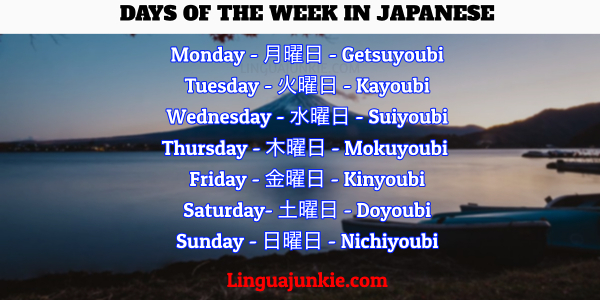
The good news? All days of the week in Japanese follow a simple pattern.
They all contain “youbi” or “曜日” in Japanese.
Which sounds like “yo B.” Get it? So, if you’re a beginner and if you hear a “youbi,” that’s how you know you heard some day of the week in Japanese.
So, here’s the list of the days of the week in Japanese.
- Monday – 月曜日 – Getsuyoubi
- Tuesday – 火曜日 – Kayoubi
- Wednesday – 水曜日 – Suiyoubi
- Thursday – 木曜日 – Mokuyoubi
- Friday – 金曜日 – Kinyoubi
- Saturday– 土曜日 – Doyoubi
- Sunday – 日曜日 – Nichiyoubi
Now you know days from Monday to Sunday.
As a bonus, here are two more words you need to know. Because the weekend is part of the week too.
- Saturday & Sunday (or the weekend) – 土日 – Donichi –
- If you’re clever, you’ll notice that “donichi” is just a combination of the first kanji from Saturday (土 – do) and Sunday (日 – nichi).
- Weekend – 週末 – Shuumatsu
Okay, now you know the days of the week. What’s next? These bonus words.
Bonus Words for Days in Japanese
Now, aside from Monday and Tuesday, there are other Japanese words you should know.
Like, “today,” “tomorrow” and “the day after tomorrow.”
Here they are.
- today – 今日 – kyou
- tomorrow – 明日 – ashita
- yesterday – 昨日 – kinou
- the day before yesterday – おととい – ototoi
- the day after tomorrow – あさって – asatte
- the other day – 先日 – senjitsu
- weekday – 平日 – heijitsu
- holiday (day off) – 休日 – kyuujitsu
- Yasumi is also acceptable
- day off – 休み – yasumi
- every day – 毎日 – mainichi
- someday – いつか – itsuka
- As in, “someday, I will learn Japanese.”
- one day – ある日 – aru hi
- As in, “One day, I woke up and decided to learn Japanese.”
- all day – 一日中 – ichnichijuu
So now you know the days in Japanese plus some relevant vocabulary.
Now, let’s move onto the days of the month in Japanese.
Days of the Month in Japanese
Now, onto days of the month in Japanese. Is it as easy as the first, the second or 15th of the month?
Well…
If you already know Japanese numbers…
…you’re sort of almost there.
You’re very close to mastering the days of the month.
There are variations that you need to memorize.
For example, the 1st of a month isn’t called “the first” or “ichi” but rather “tsuitachi.” And the 10th of the month doesn’t use “juu” which means “10.” It’s “tooka.”
But when you get to the 10s and 20s, most of them follow an easy formula, which I reveal below.
So, take a look below at the Japanese days of the month.
| Day | Japanese | Romaji | Day | Japanese | Romaji | Day | Japanese | Romaji |
| 1 | ついたち | Tsuitachi | 11 | じゅういちにち | Juuichi nichi | 21 | にじゅういちにち | nijuuichi nichi |
| 2 | ふつか | Futsuka | 12 | じゅうににち | juuni nichi | 22 | にじゅうににち | nijuuni nichi |
| 3 | みっか | Mikka | 13 | じゅうさんにち | juusan nichi | 23 | にじゅうさんにち | nijuusan nichi |
| 4 | よっか | Yokka | 14 | じゅうよっか | juuyokka | 24 | にじゅうよっか | nijuuyokka |
| 5 | いつか | Itsuka | 15 | じゅうごにち | juugo nichi | 25 | にじゅうごにち | nijuugo nichi |
| 6 | むいか | Muika | 16 | じゅうろくにち | juuroku nichi | 26 | にじゅうろくにち | nijuuroku nichi |
| 7 | なのか | Nanoka | 17 | じゅうしちにち | juushichi nichi | 27 | にじゅうしちにち | nijuushichi nichi |
| 8 | ようか | Youka | 18 | じゅうはちにち | juuhachi nichi | 28 | にじゅうはちにち | nijuuhachi nichi |
| 9 | ここのか | Kokonoka | 19 | じゅうくにち | juuku nichi | 29 | にじゅうくにち | nijuuku nichi |
| 10 | とおか | Tooka | 20 | はつか | hatsuka | 30 | さんじゅうにち | sanjuu nichi |
| 31 | さんじゅういちにち | sanjuuichi nichi |
You will need to memorize the blue ones. Mostly from 1 to 10. But 11 and up are fairly easy.
From 11 and up, most follow this formula:
- [number in japanese] + [nichi]
- 11 is juuichi + nichi = juuichi ichi
- 12 is juuni + nichi = juuni nichi
- 25 is nijuugo + nichi = nijuugo nichi
The only ones that don’t follow the formula and need memorization are:
- 14 – juuyokka
- 20 – hatsuka
- 24 – nijuuyokka
So, learning the days of the month in Japanese is just a matter of memorization. Or reviewing a lot. It’s not hard. But with enough reviews and glances you’ll get it.
So, print this lesson or save that image I have below.
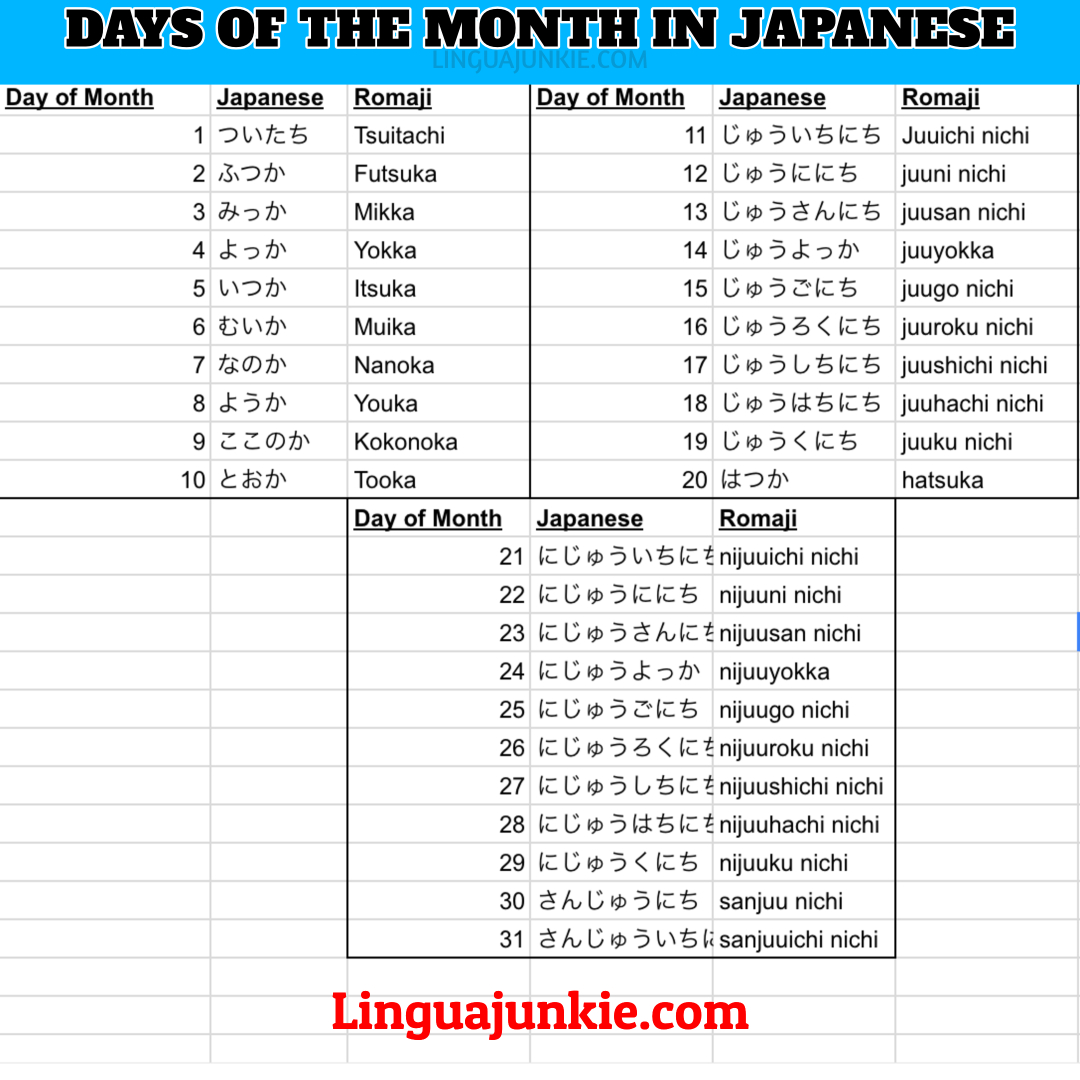
So, print this lesson or save that image I have above.
Good Example Sentences to Know
Here are some common phrases to know and use.
- What day is it today?
- 今日は何の日ですか。
- Kyou wa nan no hi desu ka?
- It’s Saturday.
- 土曜日です。
- Doyoubi desu.
- Christmas is December 25th.
- クリスマスは12月25日です。
- Kurisumasu wa juunigatsu nijuugonichi desu.
- My birthday is August 21st.
- 私の誕生日は、8月21日です。
- Watashi no tanjoubi wa, hachigatsu no nijuuichinichi desu.
- Get my lesson on Japanese birthdays here.
- It’s April first.
- 4月1日です。
- Shigatsu tsuitachi desu.
Conclusion
Done!
Now you know all the days in Japanese. Plus, you know the complicated days of the month too.
If you want to master all of these fun words and phrases, print this page out. Or, copy out the words into a notebook and write them again and again.
That fun stuff really works.
By the way, since you’re learning Japanese…
…you NEED to LISTEN to the lanugage.
So, here’s a fun audio lesson where you’ll learn some basic words and greetings. Press play and listen below right now.
- Lesson #1 – Say Hello No Matter the Time of Day
- This fun lesson is by JapanesePod101. Click here to get MORE fun lessons.
– Written by the Main Junkie
Thanks for helping me out!