Want to learn Hebrew?
Then you’ll want to learn some Hebrew summer words and phrases… because you’ll want to talk about summer.
Oh, what a coincidence… here I have a list of useful Hebrew summer words and phrases. All explained and ready for ya.

1. Kayitz
| Kayitz קיץ Summer |
Kayitz is the Hebrew word for the Summer…
And the first word you need to know on this list of Hebrew Summer Words.

2. Hufshat Kayitz
| Hufshat Kayitz חופשת קיץ summer vacation |
This phrase literally means “summer vacation.”
You combine hufsha (vacation) with kayitz (summer). Summer vacation starts in late June and lasts until end of August. This time is peak summer and perfect for travel, camps, and going to the beach.

3. Cham
| Cham חם hot |
Cham is an adjective meaning hot or warm. It can describe weather, objects, food, or even a person feeling warm. For example, yam cham would mean “hot sea water,” and yam itself is a noun.
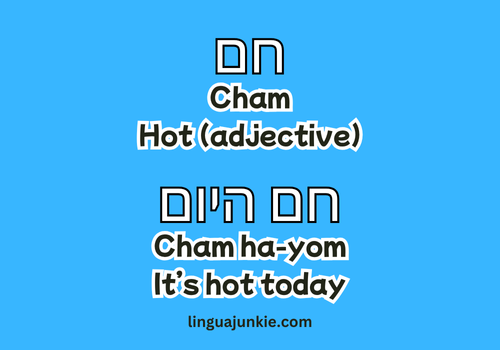
4. It’s hot
| Cham ha-yom חם היום “Hot today” |
If you want to say, “it’s hot” in Hebrew, this is the closest phrase.
Literally, the phrase means, “the day is hot”
Cham means “hot,” yom means “day,” and ha is “the.”
Another Hebrew phrase you can use is…
| (Mamash cham) ממש חם “It’s really hot.” |
Here, Mamash means “really” or “truly.”
Or, you can try…
| Eizeh chom איזה חום What heat! |
Eizeh means “what” or “such,” and chom means “heat,” so the phrase literally means “What heat!” It’s a very natural way to say “It’s so hot!”
5. Sea / Beach
| Yam ים Sea / beach |
While it literally means “sea,” yam is commonly used to mean “beach” in Hebrew.
Which brings us to the next Hebrew Summer phrase…
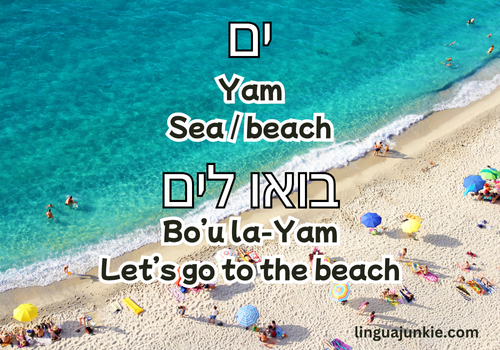
6. Let’s go to the beach
| Bo’u la-Yam בואו לים Let’s go to the beach |
This phrase means “let’s go to the beach” and comes from bo’u (come/let’s go) and la-yam (to the sea/beach).
It’s a casual phrase, used among friends when making summer plans.
Another casual variation is…
| Yalla la-yam יאללה לים Let’s go to the beach |
Yalla is a slang term meaning “let’s go” or “come on,” borrowed from Arabic, and la-yam means “to the sea/beach.”
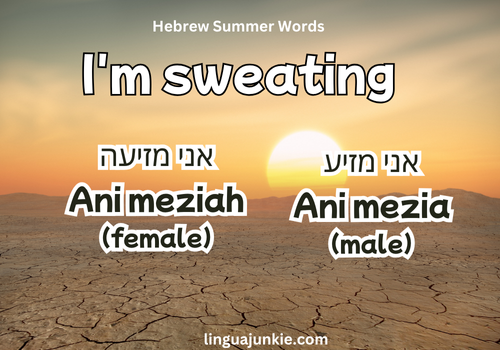
7. I’m sweating
As you may know, in Hebrew, the verb changes to match the speaker’s gender… so there are 2 ways to say this.
Female
אני מזיעה
Ani meziah
Male
אני מזיע
Ani mezia
Ani means “I,” while mezia (מזיע) is the masculine form of “am sweating” and meziah (מזיעה) is the feminine form. The verb changes ending (-a) to agree with the speaker’s gender.
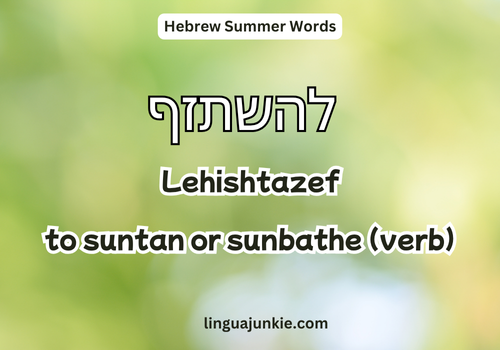
8. Lehishtazef
| Lehishtazef להשתזף to suntan or sunbathe (verb) |
Le- is the infinitive marker “to,” and hishtazef comes from the reflexive verb meaning “to tan oneself.”
It’s commonly used for sunbathing or intentionally getting a suntan during summer.
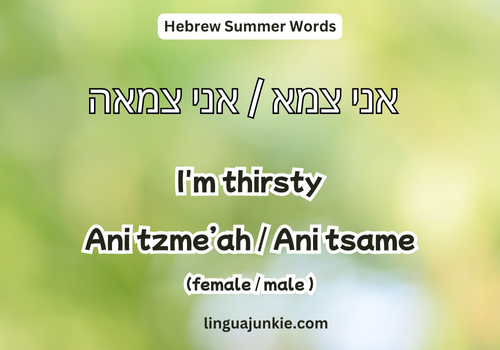
8. I’m thirsty
Here are the 2 ways to say I’m thirsty in Hebrew… on a very hot summer.
Female
אני צמאה
Ani tzme’ah
Male
אני צמא
Ani tsame
Again, different versions depending on who you are / who the speaker is.
9. Suntan
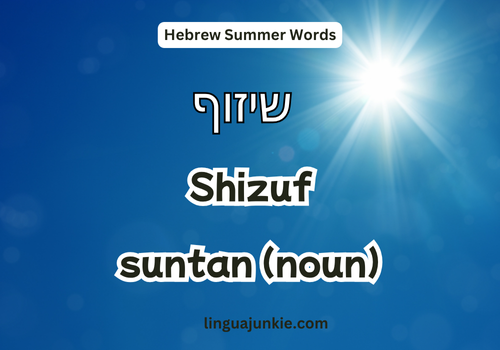
| Shizuf שיזוף suntan (noun) |
The word for “suntan,” shizuf comes from the root meaning “to scorch” or “to darken.”
Earlier you learned Lehishtazef which is a verb, so you would Lehishtazef to get a shizuf.
10. Sun
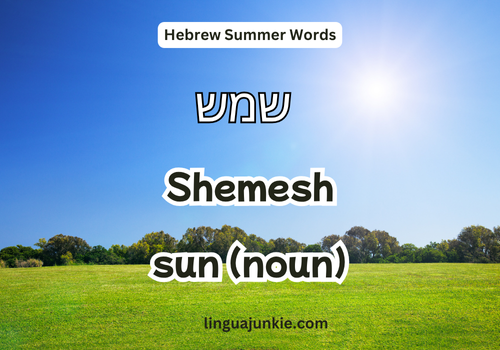
This is the Hebrew word for sun.
| Shemesh שמש sun (noun) |
It’s a feminine noun and is commonly used in summer phrases like משקפי שמש (mishkafei shemesh) for “sunglasses” or קרם שמש (krem shemesh) for “sunscreen.” It can also appear in expressions like שמש חזקה (shemesh chazaka) meaning “strong sun.”
Now speaking of shemesh and its variations…
11. Sunburn
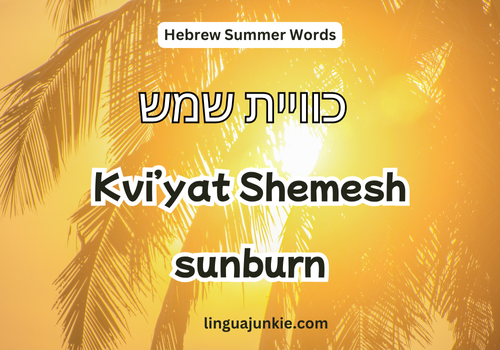
| Kvi’yat Shemesh כוויית שמש sunburn |
This phrase means “sunburn,” where kvi’yat means “burn” and shemesh means “sun.” It is commonly used to describe the red, irritated skin caused by too much sun.
12. Sunglasses
| Mishkafay shemesh משקפי שמש sunglasses (noun) |
This term means “sunglasses,” made of mishkafay (glasses) and shemesh (sun). It’s an essential summer item for eye protection and comfort during bright days.
13. Air conditioner
| Mazgan מזגן air conditioner (noun) |
The word for “air conditioner,” mazgan is derived from a root that implies controlling or regulating.
13.Ice Cream
| Glidah גלידה ice cream (noun) |
The Hebrew word for ice cream comes from Italian and Ladino (Judeo-Spanish)
Both of these languages use similar forms like “gelato” (Italian) and “helado” (Spanish).
14. I want ice cream
Female
אני רוצה גלידה
Ani rotzah glidah
Male
אני רוצה גלידה
Ani rotzeh glidah
As you may know….
Ani means “I.” Rotzeh/rotzah is the verb “want” in masculine/feminine form.
Though the Hebrew spelling for both is identical (רוצה), the pronunciation changes depending on the speaker’s gender. (rotzeh for male, rotzah for female.)
Glidah means “ice cream” as you already know.

15. Can I have ice cream?
| Efshar glidah? אפשר גלידה? Can I have ice cream? |
This phrase is gender-neutral, so anyone can use it…
And yes, both kids and adults will say it.
Because it’s a shorthand way of asking “Can I have ice cream?” without a subject or verb, there’s no need to change it based on gender.
16. Waves
| Galim גלים waves |
Galim means “waves”… and would be useful if you go to the “yam”/beach.
You might hear “הגלים גבוהים היום” (The waves are high today).
18. Israeli Summer
| Kayitz Yisraeli קיץ ישראלי Israeli summer |
So, what’s an Israeli summer? Well, it carries a bit of cultural weight… instead of just saying, “hey it’s summer here.”
This phrase refers to the dry heat and strong sunlight from June to August.
And, the phrase can also carry feelings tied to life in Israel during summer. Which means… beach trips, festivals, and so on. Referring to the whole summer vibe.
19. I don’t feel like doing anything
| Lo ba li klum לא בא לי כלום I don’t feel like doing anything. |
This phrase literally means… “Nothing is coming to me,” but in natural English it means “I don’t feel like doing anything.”
It’s commonly used when you’re tired, lazy, or just not in the mood, especially on a hot summer day when energy feels drained.
20. To burn time
| Lisrof et ha-zman לשרוף את הזמן to burn time (phrase verb) |
This is the Hebrew variation of “to kill time.” Which you’d do during the summer… when it’s super hot.
This is used when you’re just hanging out and passing time.
- לשרוף – Lisrof – to burn
- את הזמן – et ha-zman – the time (object of the verb)
21. Blazing summer
| Kayitz lohet לשרוף את הזמן Blazing summer |
This phrase is used in both spoken and written Hebrew.
It’s a bit poetic, so you might hear it in ads, headlines, or when someone’s being dramatic or expressive about the summer heat.
22. This heat is a nightmare/unbearable
| Siyut chom סיוט חום This heat is a nightmare Literally: Heat nightmare |
This phrase is informal, a bit dramatic, and very much a complaint in Hebrew.
You’ll use it when the weather is unbearably hot that it feels like a nightmare…. and you groan as you say it.
Think of it like saying “This heat is killing me, Bob,” in English.
Al tishkach krem haganah – “Don’t forget sunscreen”
23. “It’s insanely hot today” or “Scorching hot day.”
| Yom cham esh יום חם אש Scorching hot day Literally: hot fire day |
Literally “hot fire day.” This is another an exaggerated, slangy way to say it’s hot in Hebrew. Young people especially use this kind of phrasing.
You may also hear it shortened to חם אש (cham esh) -> “fire hot.”
24. The weather’s nice today.
| Mezeg avir tov יום חם אש Literally: good weather |
It’s a neutral and widely used phrase to describe pleasant, comfortable weather, often said in casual chat.
- Mezeg = mixture or temperament
- Avir = air
- Together, Mezeg avir = “weather”
- Tov = good
25. Turn on the air conditioner.
| Tadleek et ha-mazgan יום חם אש Turn on the airconditioner |
We can’t have a list of Hebrew summer words and phrases without this.
And to break it down…
- תדליק = turn on (literally “light” or “switch on”)
- את המזגן = the air conditioner
Another useful variation would be…
| Efshar lehadleek et ha-mazgan? אפשר להדליק את המזגן? Can I turn on the airconditioner? |
Extra Summer Words
Just to cover a bit more, here are some Hebrew summer words that don’t need much explanation.
| English | Hebrew | Romaji |
|---|---|---|
| Pool | בריכה | Breichah |
| Cold drink | שתייה קרה | Shtiyah karah |
| Swimsuit | בגד ים | Beged yam |
| Swim trunks | מכנסי ים | Michnasei yam |
| Sunny | שמשי | Shemeshi |
| Weather | מזג אוויר | Mezeg avir |
| Heat | חום | Chom |
| Season | עונה | Onah |
| Humidity | לחות | Lachut |
| Sweat | זיעה | Ze’ah |
| Sunscreen | קרם הגנה | Krem haganah |
| Flip-flops | כפכפים | Kafkafim |
Back to You
Well, now you know a whole bunch of Hebrew summer words.
Am I missing any?
Or is the Lachut melting your brain?
– The Main L. J.