So!
There are 4 ways to say only in Japanese: dake, nomi, shika nai and kagiri.
When do you use each one? Wellllllll… it depends!
Which is where this Linguajunkie Japanese guide comes in.

1. Dake / だけ
So, dake (pronounced – dah-keh) is the most common way to say only in Japanese.
You’ll hear it in everyday Japanese and it works almost anywhere.
With nouns, verbs, adjectives, and adverbs.
- 日本語だけ (only Japanese language)
- 動詞: 食べるだけ (just eat / only eat)
- 形容詞: 安いだけ (just cheap)
- 副詞: 少しだけ (only a little)
Here are some examples using the word dake…
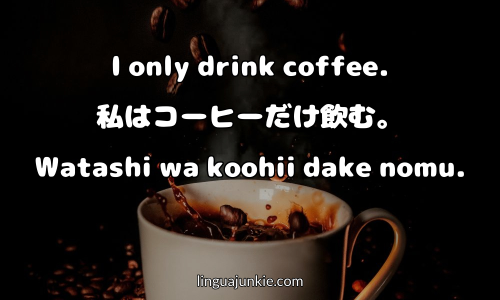
- I only drink coffee.
- 私はコーヒーだけ飲む。
- Watashi wa koohii dake nomu.
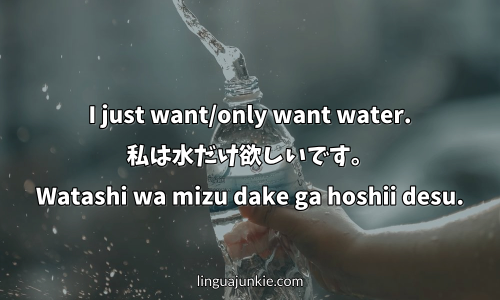
- I just want/only want water.
- 私は水だけ欲しいです。
- Watashi wa mizu dake ga hoshii desu.
- I only want you.
- 私は君だけ欲しいです。
- Watashi wa kimi dake hoshii desu.

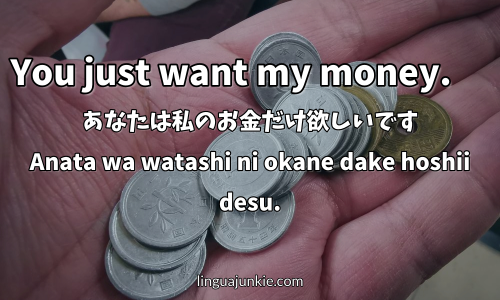
- You just want my money.
- あなたは私のお金だけ欲しいです
- Anata wa watashi ni okane dake hoshii desu.
So, if you want to say only in Japanese… use “dake.” It’s safe, neutral and doesn’t have extra nuances or limitations… unlike some of our other friends here.
Speaking of nuances and extra meanings…
Let’s look at the next one…
2. Shika ~nai / しか~ない
This is more of a grammar pattern than a word.
You add it after a noun and follow with a verb in the negative form… which ends in “nai,” which is the “nai” part of the “shika ~nai.”
For example…
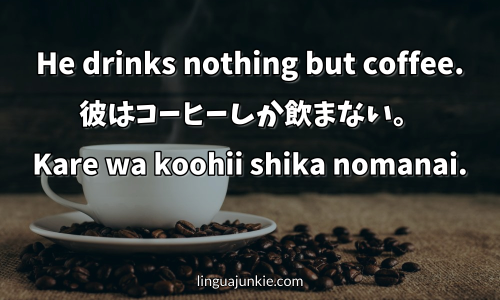
- 彼はコーヒーしか飲まない
- Kare wa koohii shika nomanai
- He drinks nothing but coffee
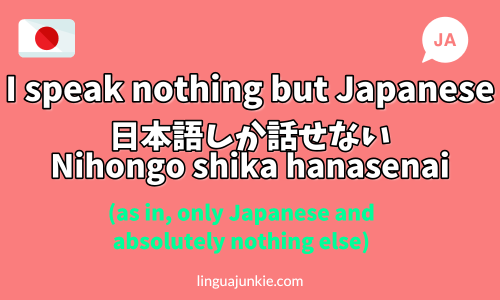
- 日本語しか話せない
- Nihongo shika hanasenai
- I speak nothing but Japanese
Of course, you can also use the polite form of the adjective and say
- 日本語しか話せません
- Nihongo shika hanasemasen
Unlike “dake,” this variation’s much stronger and shuts out all other options and possibilities. A “there’s nothing else but X” type of statement. It’s an absolute statement… unlike “dake/only.” People say “I only use X” or “I only eat Y” all the time… and then go on to use or eat other options.
So, think of dake vs shika nai as only vs nothing but.
Let’s compare sentences using dake vs shika ~nai.
- 彼はコーヒーだけ飲む。
- Kare wa koohii dake nomu.
- He only drinks coffee.
This just states the fact… and doesn’t insist that nothing else is possible.
- 彼はコーヒーしか飲まない。
- Kare wa koohii shika nomanai.
- He drinks nothing but coffee.
But this one emphasizes that coffee is the only thing he drinks… and nothing else. Regardless of time, day, health, mood, location, or availability of other drinks like water or Japanese green tea.
At which point, someone’ll ask, “wait, is that the only thing he drinks? Is he crazy?” and the answer is indeed a “yeah.”
3. Nomi (のみ)
You don’t have to worry about nomi as much.
Nomi’s just a very formal or written version of “dake.”
You won’t hear it in casual context from your Japanese friend, Taro. You’ll hear it from store staff, business people, business announcements… and see it in documents, manuals, and business communication.
So, where would YOU come across this as a regular Lingua Junkie Joe?
For example, if you go to a store and ask if you can use cash but they say… カードのみ (ka-do nomi) meaning “only credit card.” That’s where you’d likely run into a nomi. Your friends on the other hand would say カードだけ (ka-do dake).
4. Kagiri (限り)
Kagiri has a nuance of a restriction and it shows up often in rules, conditions, or set phrases.
With nouns, it often just means “limited to” or “for these people only.”
- この割引は学生に限ります
- Kono waribiki wa gakusei kagirimasu
- This discount is limited to students
This statement feels like an official policy and not a casual comment.
Compared to “dake” and “nomi”, “kagiri” is less about listing “only” and more about drawing a line.
It’s essentially saying “within this limit, and nowhere beyond.”
It’s very common in written Japanese, contracts, or formal rules, but less so in everyday conversation.
You won’t hear your friend Taro say it but you’ll see it in ads, contracts, or people that want to sound clear and serious. Like teachers, bosses, and old folk… bless their hearts.
Only Japanese Learners Can Read This Last
Oh… you’re here at the end.
Since you’re learning Japanese…
Let’s recap these 4 ways to say only in Japanese into your head once and for all.
How? With a quick chart that sets them apart.
| Type | Explanation |
|---|---|
| だけ (dake) | Neutral and flexible “only.” Attaches to nouns, verbs, adjectives, adverbs. Used in daily conversation to mark limitation without strong exclusion. |
| のみ (nomi) | Formal/written version of だけ. Attaches mainly to nouns and numbers. Common on signs, manuals, and business notices. Rare in casual talk. |
| しか~ない (shika ~ nai) | Always attaches to nouns and must pair with a negative verb. Strong exclusion: “nothing but X.” Emphatic and absolute compared to だけ. |
| 限り (kagiri) | Attaches to nouns or clauses. Means “limited to” or “as long as.” Often used in rules, policies, contracts, or formal speech; less common in casual talk. |
Anyway, thanks for only reading my blog.
I hope you’re not reading any others.
My blog dake!
The Main Junkie
Nice balance of theory and practical advice. Well done!