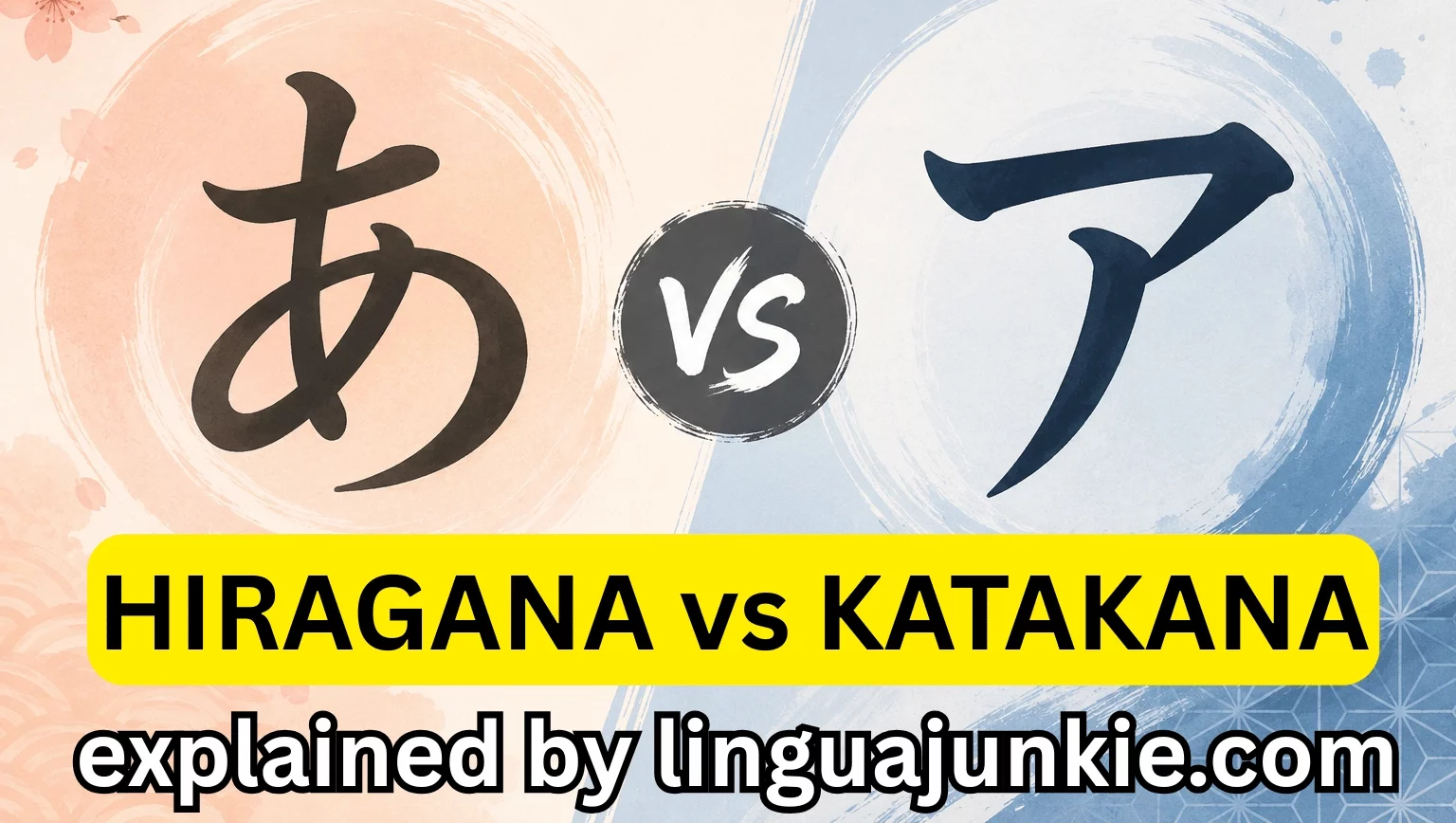
So… Hiragana vs Katakana, eh?
Two scripts, same sounds, totally different jobs. This Linguajunkie guide will ‘splain it all to ‘ya, okay
Key Differences & Similarities
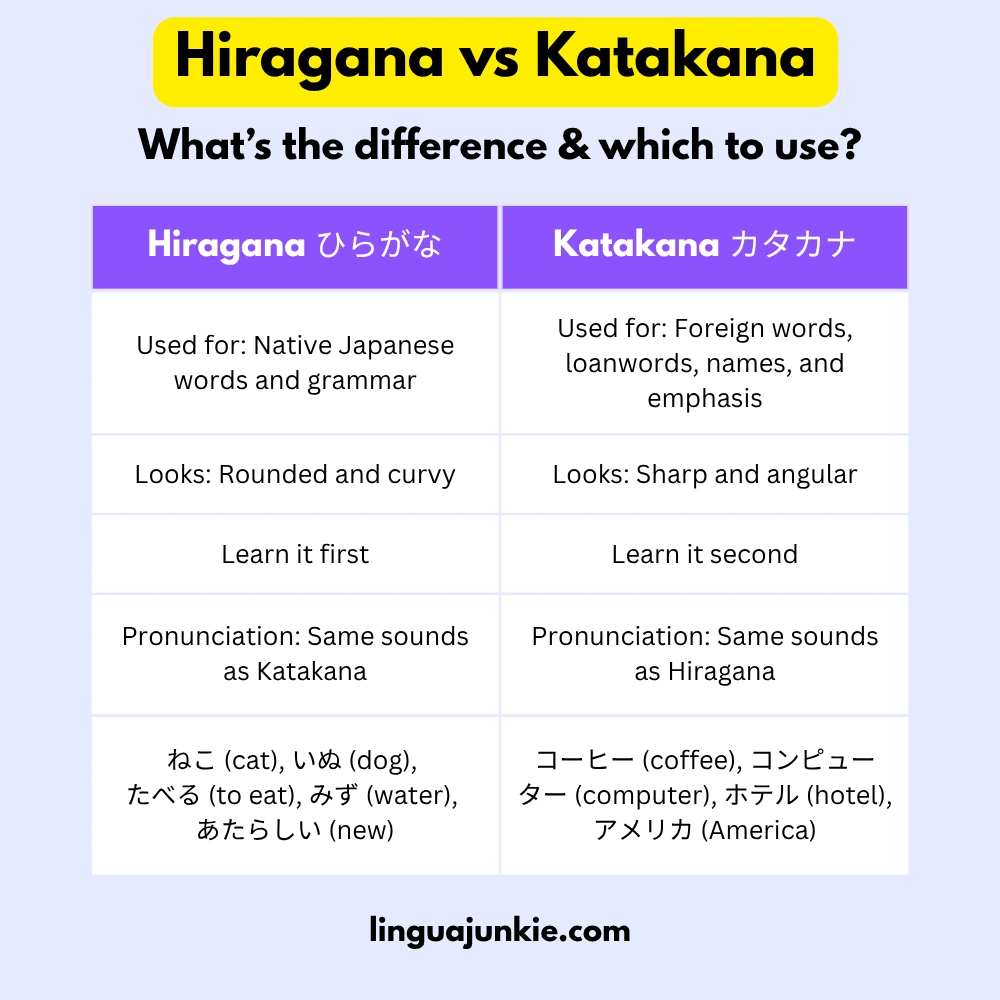
By the way, instead of saying Hiragana vs Katakana, the two are collectively referred to as “Kana.” Okay?
So, here’s the deal with these 2 Japanese writing systems…
- Hiragana (ひらがな) are the soft, curvy characters used for native words, particles, and verb endings. Just look below to see what I mean.
- Katakana (カタカナ) are the sharp, angular characters used mostly for foreign loanwords, names, and emphasis. Look, much sharper and straighter, eh?
Both consist of 46 characters.
Just different versions of the same thing. Like twins that don’t look alike… and one is smart and the other is good at sports.
Both alphabets are what you’d call…”syllabaries.” That means each character represents a syllable sound (ah, oh ka, shi, to) instead of a single letter like in the English alphabet.
Hiragana and katakana cover the same set of sounds... か (ka) and カ (ka) are pronounced identically.
So, the difference is how they look and when you use ’em, got it?
By the way, click on the button below (whether both, hiragana, or katakana) to see the two side by side.
Hiragana & Katakana in Detail
Hiragana Explained
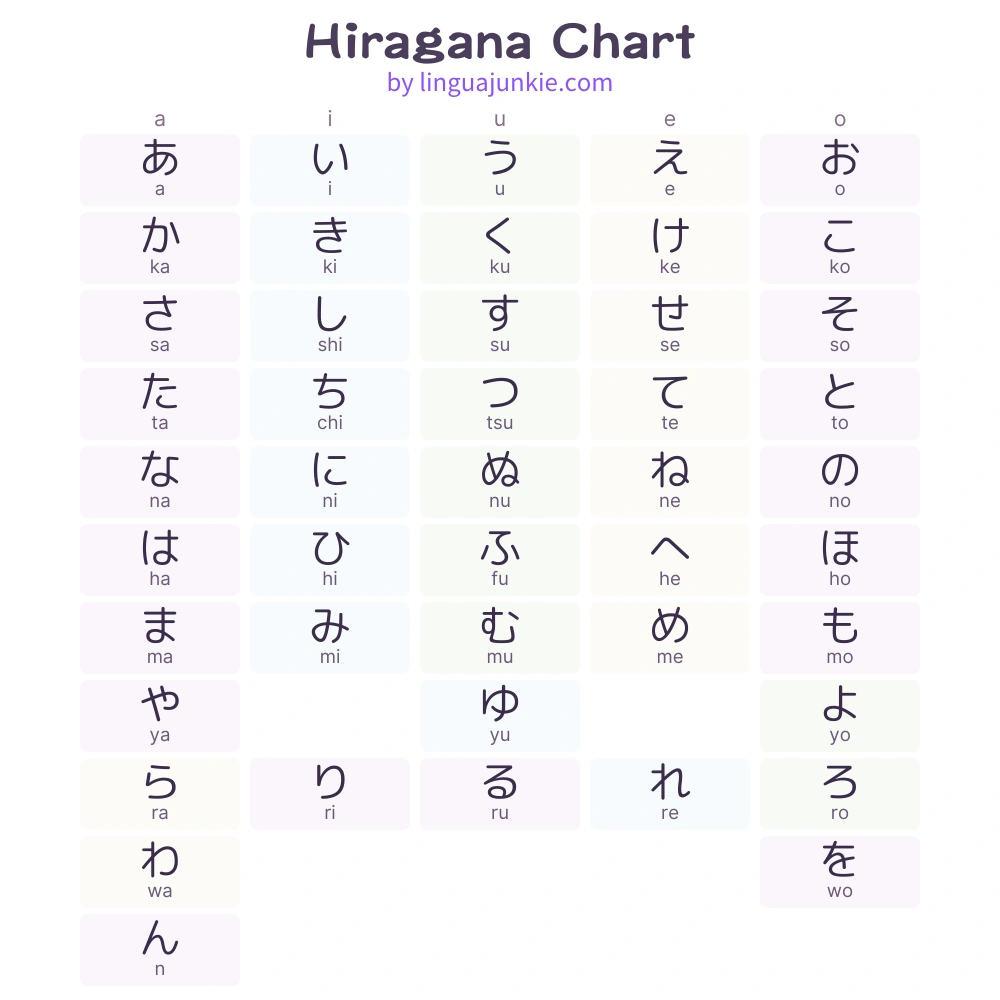
Hiragana is the first script Japanese children learn… and what you should learn first too. This is the foundation of the Japanese writing system. You’ll see it used for:
- Native Japanese words that don’t have a kanji, or when the kanji is too obscure to bother with
- Grammatical parts… like particles such as は (wa), を (wo), and に (ni), as well as verb and adjective endings
- Furigana … the small hiragana printed above kanji to show the readings.
Visually, hiragana characters are flowing and round. Lots of loops and curves. For example: あ (a), の (no), す (su), ん (n).
Here are some examples of words in Hiragana….
| Hiragana | Romaji | Meaning |
|---|---|---|
| ねこ | neko | cat |
| いぬ | inu | dog |
| みず | mizu | water |
| やま | yama | mountain |
| たべる | taberu | to eat |
| ありがとう | arigatou | thank you |
| わたし | watashi | I / me |
| ともだち | tomodachi | friend |
Katakana Explained
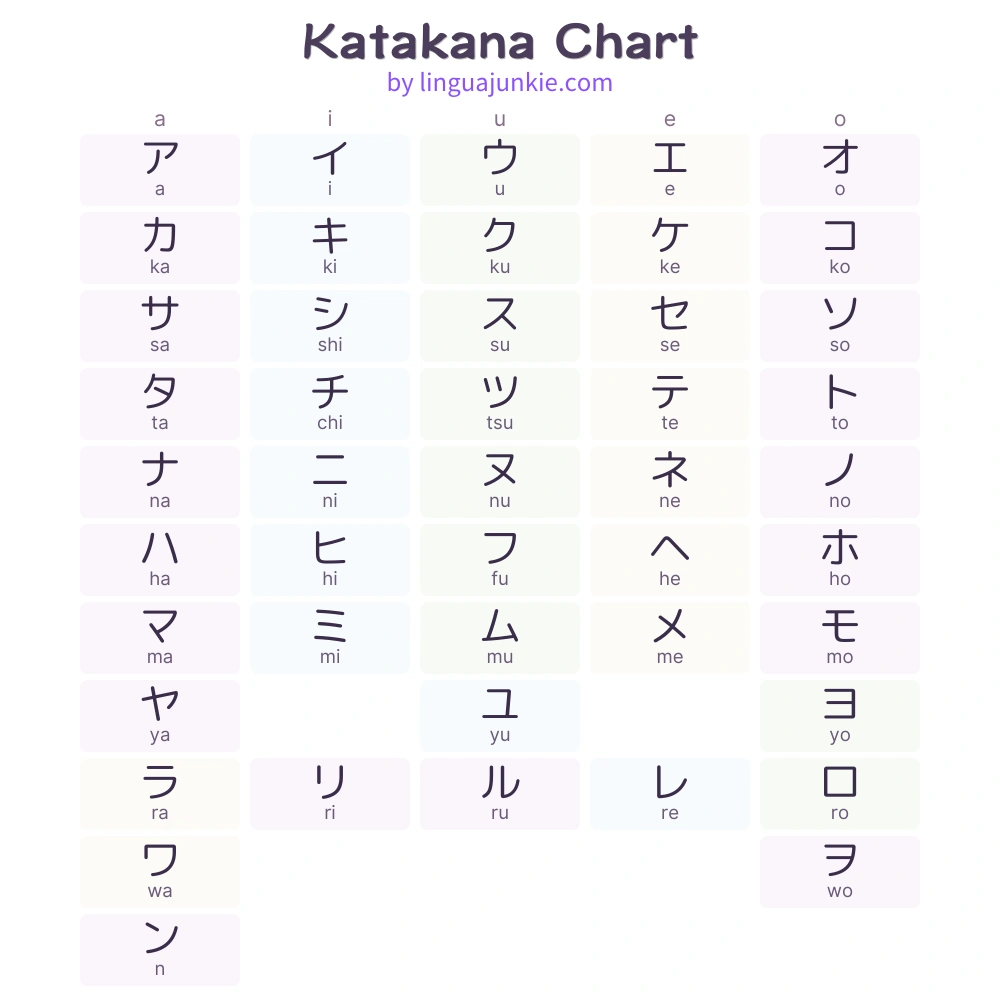
Katakana exists mostly for words that aren’t originally Japanese. Words that were borrowed from other languages.
Its main uses are for…
- Loanwords from other languages such as コーヒー (kōhī, “coffee”) and テレビ (terebi, “television”)
- Foreign names and place names such as アメリカ (Amerika, “America”) and トム (Tomu, “Tom”)
- My “what’s my name in Japanese guide” mentions this.
- Onomatopoeia and sound effects, especially in manga
- Emphasis, similar to how English uses italics or ALL CAPS
Katakana characters are more angular, sharp and blocky.
Straight lines and sharp corners. Like a slash of a sword.
For example: ア (a), ノ (no), ス (su), ン (n). Notice how ノ (katakana “no”) and の (hiragana “no”) represent the same sound but look nothing alike.
Here are some examples of words in Katakana….
| Katakana | Romaji | Meaning |
|---|---|---|
| コーヒー | kōhī | coffee |
| テレビ | terebi | television |
| アメリカ | Amerika | America |
| フランス | Furansu | France |
| イギリス | Igirisu | England/UK |
| カメラ | kamera | camera |
| レストラン | resutoran | restaurant |
| インターネット | intānetto | internet |
A Few Extra Marks Worth Knowing
The 46 basic characters in each script aren’t the end.
There’s still a handful of small marks extend them to cover more sounds:
- Dakuten ゛ – Dakuten is a small double-tick mark added to a character. It changes the sound of certain consonants: か (ka) becomes が (ga), は (ha) becomes ば (ba).
- Handakuten ゜-Handakuten is a small circle, and also changes the sound. It is used only with the h-row: は (ha) becomes ぱ (pa).
- Small ゃ/ゅ/ょ These small ya/yu/yo combine with certain characters to make blended sounds… like き (ki) + small ゃ becomes きゃ (kya).
- Small っ — marks a doubled consonant, like the difference between かた (kata) and かった (katta).
These little marks work the same way in both hiragana and katakana, so once you’ve learned ’em, it’s no big deal.
Where Did These Two Scripts Come From?
Knowing their origin makes the “curvy vs. angular” distinction easier to understand.
So, both scripts came from kanji, but in different ways.
Hiragana came from writing whole kanji characters in fast, flowing cursive script….
Over time, that got simplified into the soft, looping shapes used today. So, that’s why hiragana looks round and curvaceous. Mmm, oh yeah.
Katakana came from taking just a small fragment of a kanji… whether a corner, a stroke or two… as shorthand. That’s why katakana looks so sharp and pointy. Ouch! (Who left out this pointy sharp thing in the open?)
It’s a piece cut out rather than a whole character softened.
Why Not Just Use One?
You might wonder why in the world there are 2 scripts… and many beginners complain about it.
However, the split makes reading easier once you’re used to it.
Because katakana visually flags foreign words, your brain can instantly recognize “this is a loanword” without needing to know more.
Also, Japanese writing does not use spaces so….
Mixing hiragana, katakana, and kanji in a single sentence also breaks up the text visually, making words easier to see…
How They Work Together
Here’s a sentence using all three scripts together:
私はコーヒーを飲みます。
Watashi wa kōhī wo nomimasu. (“I drink coffee.”)
- 私 (watashi, “I”) — kanji
- は (wa) — hiragana particle
- コーヒー (kōhī, “coffee”) — katakana, since it’s a loanword
- を (o) — hiragana particle
- 飲みます (nomimasu, “drink”) — kanji stem + hiragana verb ending
Tips for Learning Hiragana vs Katakana
So, how should you learn ’em? Well, before we get into the resources…
- Learn hiragana first, katakana second. Hiragana’s more common and forms the basis for reading kanji pronunciations.
- Exposure is key. First learn your Hiragana and Katakana (both are referred to as kana). Then, for it all to stick, you need to continue on learning the language itself… and getting used to the words.
Now, for TOOLS for learning Hiragana and Katakana, you’ll be wasting your time if you get some app.
The best way is and has always been to practice writing things out, not tapping on apps. And importantly, you can pretty much do it ALL for free. How?
For this… there are a few resources I will suggest…
- My resources…
- If you want something a bit more structured and legit…
- Hiragana Free 7 Day Challenge by JapanesePod101
- Kana Writing Workbook by JapanesePod101
Once you’ve mastered the characters, your next job is to practice and use them as much as possible. So, for that, you should already have some main resource: a Japanese textbook or a good Japanese program.
Also, I have this Hiragana Katakana Practice Quiz (a speed game testing you on the characters.)
Frequently Asked Questions
Should I learn hiragana or katakana first? Hiragana. Then Katakana.
Do hiragana and katakana represent different sounds? No, didn’t you read this guide? They represent exact same sounds. あ and ア are both “a,” か and カ are both “ka.” Only the shape and the uses are different.
How long does it take to learn each script? Schools take a week to teach learners both. However, that’s school… learning speed varies otherwise if you’re learning alone. Some people struggle with learning all in such a short time and it takes them longer.
What’s the best way to learn Hiragana and Katakana? Apps are a waste of time and avoid anything paid. The best way is to simply practice writing with the resources I gave above.
What do I do after I learned Hiragana and Katakana? First, don’t move onto Kanji. Your only job is to “continue” learning Japanese with a main resource like JapanesePod101 or a textbook. As you learn and continue, the exposure to characters will solidify them into your brain and the resource will teach you Kanji along the way anyway. Sorry, this is where rinky-dinky apps can’t help.
Back to You, Junkie
So…
Now you now that Kana (Hiragana and katakana) are NOT competing systems.
They’re different characters for the same exact sounds…
They just look different and have different uses.
So hack to you. If ‘ya got any questions, leave a comment. If not, go on with your Japanese learning.