
The simplest way to say good luck in Japanese is…
This word —
Now, is it an exact translation of “good luck?” Not really, but it’s the closest phrase. Why? You’ll learn below.
And in this guide, you’ll learn many ways to say good luck in Japanese. So, keep on reading.
And remember… “ganbatte.”
Want a pack of 30+ Japanese PDF Lessons? These colorful, printable PDFs teach you Japanese words and phrases… and they’re free for new learners. Click here to get Japanese PDF Lessons |
Good Luck Phrases in Japanese
Slideshow
Watch phrases here… or scroll down to read the in-depth explanations and enjoy the images.
Want a pack of 30+ Japanese PDF Lessons? These colorful, printable PDFs teach you Japanese words and phrases… and they’re free for new learners.
Click here to get Japanese PDF Lessons →1. 頑張って!
Ganbatte
Try your best!
Ganbatte in Japanese means to try your best.
This is one of the most encouraging Japanese phrases…
…and is MOST similar to “good luck.” It encourages the other person to do their best and can be a great phrase to use for “good luck.”
Instead of relying on luck, Japanese people believe that success and good outcomes come from trying and putting in effort.
This belief could be why few good direct translations of “good luck” in Japanese exist.

A more polite version is… where you just add “kudasai” — meaning, please in Japanese.
- 頑張ってください
- Ganbatte kudasai
2. うまく行くといいね
Umaku iku to iine
I hope it goes well
This phrase is another one of the best ways to say good luck in Japanese.
If you have a friend anticipating something important coming up, you can try using this phrase!

3. 幸運を祈ります
Kou un o inori masu
I pray for good luck
The closest direct translation to “good luck” is kou un o inori masu.
However, in everyday speech, this can be awkward.
It sounds formal, and it is not colloquial language.
However, this could be the correct phrase if you genuinely want to wish someone luck.
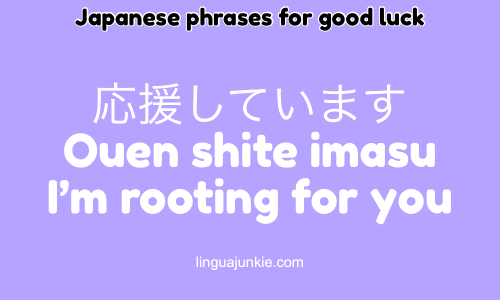
4. 応援しています
Ouen shite imasu
I’m rooting for you
In situations when you wish someone luck, you might actually mean that you’re rooting for them and cheering them on.
So, “Ouen shite imasu” can be a great phrase to use in this situation.
For example, if your friend is on a sports team with a big event coming up, you could try saying this phrase as good luck.
5. 気をつけてね
Ki o tsukete ne
Take care of yourself
The phrase “good luck” can also be used during farewells (when you say bye in Japanese)….
In this situation, ki o tsukete ne, could be a great alternative as it wishes for their health while they are away and moving on to new things — a good Japanese health saying to know.

6. 元気でね
Genki de ne!
Stay healthy!
Another way to wish someone good luck when they are leaving is genki de ne.
This is a great phrase because instead of wishing generic luck, you are wishing them to stay well and healthy.

The Japanese like to wish people health instead of directly wishing them luck, as health is one of the most important things for accomplishing things.
7. ファイト
Faito
Fight!
This is the English word “fight” in Katakana.
What does faito mean in Japanese?
It can mean similar to ganbare in Japanese.
Instead of a violent connotation of fighting, this word just means “do your best” and be determined to win or accomplish your goals. It can be a friendly phrase to use if you want to wish someone some luck.

10. これからも頑張ってね
Kore kara mo ganbatte ne
Try your best from now on
This is another great parting phrase (a way to say bye in Japanese)…
…if you want to wish someone “good luck” in their future endeavors.
Korekaramo means “from now on just like before,” which shows that you respect their hard work and wish them the best as they move on to new things.
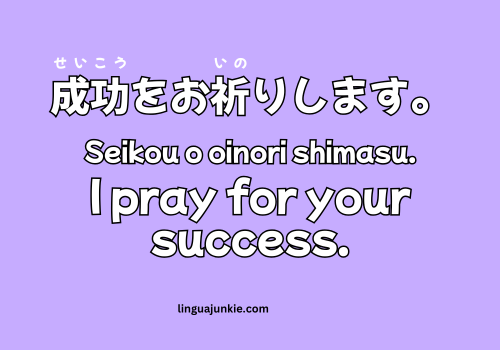
11. 成功をお祈りします。
Seikou o oinori shimasu.
I pray for your success.
If you want to wish someone success, this could be a powerful phrase.
It is more formal, so you might not want to use it in normal daily speech.
Instead, it could fit well inside a handwritten letter.
Instead of wishing someone good luck, you can wish them success, which is a similar concept!
- Related: Japanese success quotes
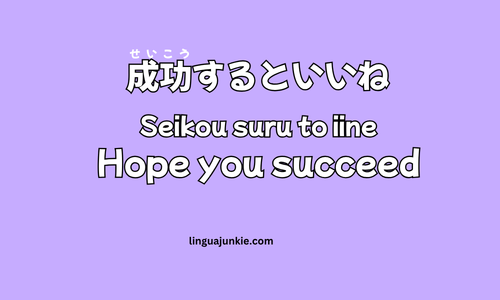
12. 成功するといいね
Seikou suru to iine
Hope you succeed
Unlike the previous example, this phrase can be used if you want to be a bit more casual and friendly.
It can be a great phrase to use with your friends and family when you want to wish them the best and luck for the future.
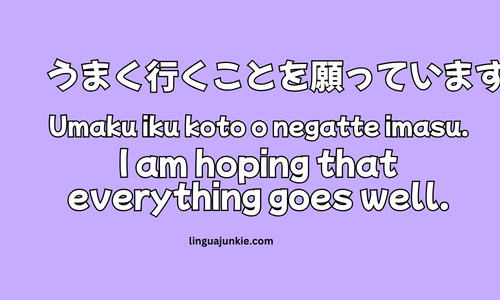
13. うまく行くことを願っています。
Umaku iku koto o negatte imasu.
I am hoping that everything goes well.
This is a more formal phrase when you hope everything goes well.
It is a suitable replacement for good luck, as you hope things turn out positively.
You can use this phrase in polite situations, such as with unfamiliar acquaintances.
14. ご活躍を応援しています。
Go katsuyaku o ouen shite imasu.
I’m rooting for your success.
An interesting way to wish someone luck is to use this phrase.
It is a formal phrase, but it shows that you are rooting for their success.
The word katsuyaku in Japanese means to flourish or be actively successful.
Usually, it is used when you wish someone career success in the future so that they can be recognized in their field someday.
Ganbare vs. Ganbatte
Ganbatte is a common phrase…
And you’ll also hear variations. Like, ganbare.
So, what’s the difference between ganbare and ganbatte?
“Ganbare” and “Ganbatte” both mean “Do your best” or “Good luck” in Japanese…
But they’re used a bit differently.
- Ganbare (がんばれ) is a strong, direct encouragement. It’s like yelling, “Let’s GOOOO!” or “Get ’em!!” at the top of your lungs. It’s often used to cheer someone on or to push them to do their best, especially in a challenging situation.
- Ganbatte (がんばって) is softer and more polite. It’s like saying, “Do your best” or “Hang in there.” It’s often used in everyday situations, like before a test or sports event.

Remember, Ganbare is stronger and more forceful.
Ganbatte is friendlier and more casual.
Back to You
You’re at the end – and you read it all!
I was going to say good luck in Japanese… but you don’t need it.
If you enjoyed these Japanese phrases…
You might also like these other related lessons of mine. Click on the links below.
- 38 positive japanese words and phrases
- part 2 here – positive japanese quotes
- 20+ japanese success quotes
Which phrase was your favorite?
Leave a comment!

[…] How do you say good luck in Japanese? […]