Want to know how to decide in Japanese…?
Good, because I’ve decided to teach you how.
You’ll learn the 3 most common ways to say decide in Japanese.
- verb + koto ni suru
- verb + koto ni naru
- kimaru/kimeru
Ready? Did you decide to keep going? Then read on.

1. Verb + Koto ni suru
- Verb (dictionary form) + ことにする
- Verb + koto ni suru
- I decided to (verb) or I’ve decided to (verb)
So, verb + koto ni suru is when YOU make a decision.
When it’s your personal choice or goal. You can use it for big life choices or small things like cleaning your earwax.
For example…
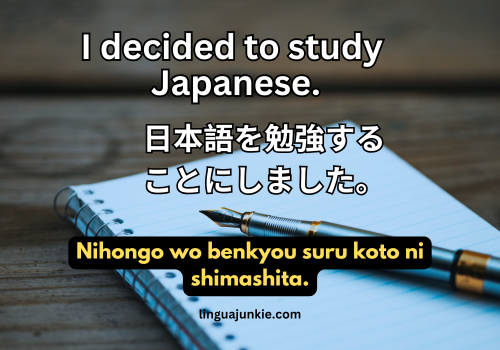
- 日本語を勉強することにしました。
- Nihongo wo benkyou suru koto ni shimashita
- I decided to study Japanese.
- Nihongo wo benkyou suru koto ni shimashita
- 海に行くことにする。
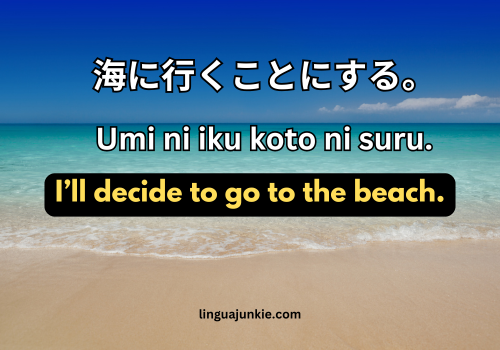
- Umi ni iku koto ni suru.
- I’ll decide to go to the beach.
- Umi ni iku koto ni suru.
Note that this example uses the present/future tense of the verb “suru.” So, it’s “I will decide to go” instead of “I’ve decided.”
- 毎日走ることにした。
- Mainichi hashiru koto ni shita.
- I decided to run every day.
- Mainichi hashiru koto ni shita.

So, how do you use this koto ni suru?
Use this form when you’re telling someone about your plan or goal in Japanese.
Often after some quiet thought or reflection.
This form focuses on the action you’re about to take rather than the act of choosing.
You’ll often hear it in daily conversation when someone says they’ve decided to start exercising, cut back on snacks, or go somewhere. The tone is soft and natural… like a casual update rather than a dramatic announcement.
For a more dramatic announcement, you’ll want to use “kimeru,” which you’ll learn about below.
So, if you say… 日本に行くことにした…
You’ve simply settled on going to Japan, maybe after thinking about it for a while.
Note, you can also use the present tense form する (instead of した or しました) when the decision is being made now or just about to be made.
Now, let’s move onto another way to decide in Japanese..,
2. Verb + Koto Ni Naru
Sometimes in life…
Things are decided for us… and things happen to us.
Which is where this grammar point comes in.
- Verb (dictionary form) + ことになる
- Verb + koto ni naru
- It was decided that… / It turns out that…
This one looks almost the same as ~ことにする…
But, the meaning is totally different.
Use this phrasing when something is decided by others or by the situation.
Like your mom decided it for you. Or, a meteor landed in your backyard so now you’re apparently staying home. Or a plate that you were holding dropped on its own, broke, cut your hand and now you gotta go to the doctor.
If this sounds a bit confusing….
Here are some ways this is phrased in English…
- It turns out (that)…
- It’s been decided (that)…
- Apparently, I’m… / Apparently, we’re…
- I’ve ended up (doing)…
- The plan is (that)…
- We’ll be… / I’ll be… (future plan or arrangement)
- Looks like I’m going to…
- I was told to… / I have to… (when the decision was imposed)
- I guess I will be (doing something)
- It just happens that I’ll be
Now, let’s look at some examples for verb + koto ni naru.
- Looks like I’m going to move.
- 引っ越すことになりました。
- Hikkosu koto ni narimashita
- It turns out I’m going to Japan.
- 日本に行くことになった。
- Nihon ni iku koto ni natta.
- It’s been decided I’ll go.
- 行くことになった。
- Iku koto ni natta.
- I guess I’ll stay home.
- うちにいることになった。
- Uchi ni iru koto ni natta.
You can think of this pattern as something like: “That’s just how it worked out.”
You didn’t choose it, but now it’s the plan.
Koto ni Suru vs Koto ni Naru
Here’s a quick recap of when to use which pattern.
| Japanese | Who decides? | English meaning |
|---|---|---|
| Verbことにする (verb koto ni suru) | You decide | I decided to… |
| Verbことになる (verb koto ni naru) | Others/situation decide | It’s been decided that… |
Here’s a quick example to show the difference between the two…
- 旅行に行くことにした。
- Ryoukou ni iku koto ni shia
- I decided to go on a trip. (I made the choice.)
- 旅行に行くことになった。
- Ryoukou ni iku koto ni natta.
- It was decided that I’ll go on a trip. (Someone else or the situation made it happen.)
3. Kimeru & Kimaru
Finally, there are these 2 verbs that mean “to decide” in Japanese.
Kimaru 決まる (きまる)
- Intransitive verb
- Meaning: “Something is decided” or “has been settled.”
Kimaru means “to be decided.” It’s an intransitive verb, so it describes something being decided, not someone deciding it.
- 日にちが決まりました。
- Hinichi ga kimarimashita.
- The date has been decided.
Kimeru 決める(きめる)
- transitive verb
- Meaning: to decide
For example…
- 昼ごはんはピザに決めた。
- Hirugohan wa piza ni kimeta.
- I chose pizza for lunch.
There is some extra nuance to this kimeru.
You use it
So, in short…
- 決まる = to be decided (passive idea)
- 決める = to decide (active, you choose)
Kimeru vs Koto ni Suru
Now…
Both 決める and 〜ことにする come off almost the same, huh?
Both mean to “to decide.”
But both carry different tones.
決める expresses the act of making a decision and sounds more final. In English, it’s kind of like…
- I’ve decided once and for all…
- That’s it! I made the decision to…
- I chose to…
- That’s final. I’ve had enough!
- I’ve made up my mind, no turning back.
ことにする feels more personal and reflective, often used when someone settles on a course of action after a lot of thinking. In English, you’d say it as…
- I’ve decided to…
- I’ve made up my mind to…
- I’ve settled on…
- I think I’ll go with…
- I’m going to start…
Now, let’s look at some examples.
First…
日本に行くことにした。
Nihon ni iku koto ni shita.
I decided to go to Japan
Koto ni Suru: This sounds like a personal decision, maybe one made calmly after thinking it over.
日本に行くと決めた。
Nihon ni iku to kimeta.
I decided to go to Japan.
Kimeru: This feels stronger, like you’ve drawn a clear line and have decided… maybe after debating or struggling.
So, while both are ways to say decide in Japanese…
Koto ni Suru sounds like a calm personal choice you’re moving forward with… and highlights the action you’re going to take.
Kimeru highlights the firmness or clarity of the decision itself. It’s about the decision you’ve made…. not what you’re going to do. When things are about the “decision,” it’s usually after some pain, anger, or frustration, right?
Bonus: Casual and Polite Forms
All of the patterns above can be made casual or polite depending on how you end the sentence.
| Casual | Polite |
|---|---|
| ~ことにする | ~ことにします |
| ~ことになった | ~ことになりました |
| 決まった | 決まりました |
When to Use Each One?
| Situation | Pattern |
|---|---|
| You made a personal decision | ~ことにする |
| A plan or outcome was decided for you | ~ことになる |
| Something has been officially set | 決まる |
| You actively chose something | 決める |
Back to You
Saying to “decide” in Japanese can feel tricky,,,
There are different patterns for different situations.
So, here’s the quick recap again:
- ~ことにする = I decided to do
- ~ことになる = It was decided that
- 決まる(きまる) = Something is decided
- 決める(きめる) = I decide (something)
Now you tell me what you’ve decided to do.
Leave me a comment.
I read ’em all.
I’ve decided to learn Japanese!