In Japanese, there is no accurate translation of “I miss you”.
So, if you want to convey this meaning, you’ll have to use other words and phrases.
And that’s where this guide comes in — how to say I miss you in Japanese — the 14 ways!
By the way, if you want 30+ FREE Japanese PDF Lessons… You can access them via the button – which will open a popup and take you there. Click the button.

1. 会いたい
- Aitai
- Literally: I want to meet you
The closest way to say I miss you in Japanese is… aitai, meaning “I want to meet you.”
The desire to meet someone can also imply that you miss them since they are not around.

When using this phrase, it is important to make sure the other person knows you miss them and not that you simply want to meet them.
There are different ways to say “I miss you” in varying degrees of closeness and directness that you should consider when choosing the right words.
2. いなくて寂しい
- Inaku te sabishii
- I feel lonely without you
Another indirect way to say I miss you in Japanese.
This phrase is helpful if you feel lonely without the other person and miss them.

It could also be applicable if your best friend recently moved away and you feel a sense of longing and loneliness.
Samishii/sabishii can simply mean lonely, so it might not be that you miss someone but more that you feel empty.
When using this phrase, you should try to be clear that you feel lonely because you miss the other person.
3. また___に行きたい
- Mata __ni ikitai
- I want to go to ___ again
Japanese people tend not to say I miss you directly…
So, this is another phrase that indirectly communicates you miss someone.
If you insert the location of the person you’re missing in the blank for this phrase, you can convey that you miss them and want to see them again.
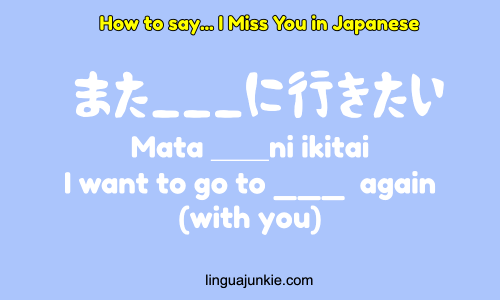
For example, if you say また日本に行きたい (mata nihon ni ikitai) or “I want to go to Japan again” to your Japanese friend, it implies that you miss them and want to see them again.
4. 会いたくてたまらない
- Aitaku te tamaranai
- I can’t wait to meet you
You can use this phrase with people close to you to show that you miss them.
Tamaranai can mean unbearable, which conveys a profound sense of missing someone.

This powerful phrase has a passionate connotation, so it might be best to use it with a romantic partner.
5. 恋しい
- Koishii
- I deeply long for you
Koishii is an intense way to express that you miss someone.
It can have a romantic connotation but can also be used to say that you miss a particular food or place.

It evokes a poetic and nostalgic feeling, and it can appear in many Japanese songs, poems, and literature.
6. 寂しくてたまらない
- Sabishikute tamaranai
- I’m so lonely I can’t bear it.
Another passionate way to say you miss someone is to use tamaranai with sabishii.
Combining these two words lets you express that you feel so lonely it is unbearable without the other person.

With this phrase, you have to make sure the other person knows you’re saying this because they are not with you, or it can sound like you are simply lonely.
7. 懐かしい
- Natsukashii
- Nostalgic/I feel nostalgic
Alone, it’s just an adjective meaning nostalgic.
But in the right context, this word is a great way to say that you miss someone in Japanese.

Feeling nostalgic can mean missing the person, the experiences, the surroundings, and the past as a whole.
Natsukashii is a very neutral way to say that you miss someone and the time you spent with them.
Compared to the phrase “I miss you,” it does lack the meaning that you might want to see them in the future.
8. 忘れられない
- Wasurerarenai
- It was unforgettable
- Literally: Unable to forget
This phrase expresses how unforgettable someone was.
It is also a way to say you miss someone in Japanese, often used when you’ve lost someone special.

9. あなたのことをいつも考えてる
- Anata no koto o itsumo kangae teru
- I’m always thinking about you.
This phrase is a romantic way to say you miss someone by constantly thinking about them and longing to be with them.
The best way to use this is mainly in romantic situations since it could come across as too strong with friends and family.

10. 切ない
- Setsunai
- The heart-aching feeling of longing
Setsunai is challenging to translate into English, but it can have a similar feeling of missing someone.
This word can represent a sweet but painful longing for something or someone that is no longer.

For example, when you can no longer be with someone you love because they must move away due to external circumstances.
Setsunai can convey that you miss someone in Japanese, but it is also usually a romantic feeling.
11. 未練
- Miren
- Lingering affection
Miren can mean that you miss someone for whom you still have feelings.
It usually applies to an ex-lover where you still haven’t moved on.

In a way, it also means that you miss them as you haven’t been able to forget your feelings for them.
Miren is a unique Japanese phrase because it conveys how you are still holding on to the past and haven’t lost the emotional tare connecting you with them.
12. いつも思い出す。
- Itsumo omoidasu
- I always remember about it
Another way to say you miss someone is to always remember them.
Itsumo omoidasu could be the best phrase if you lose someone close to you.

Seeing their favorite flower or visiting a particular park can trigger your feelings of missing them.
This phrase captures the feeling of remembering and longing and how the lack of their presence continues to influence your feelings and thoughts.
If You’re Feeling Fuzzy…
If you’re feeling warm and fuzzy for more Japanese phrases like this…
Check out these other lessons of mine.
Read This Last + Free Bonus
Now you know how to say I miss you in Japanese.
And you also know that there’s no literal way to say I miss you in Japanesse…
…because the language and culture work differently.
The closest phrase you may need is simply “aitai.”
Anyway, if you enjoyed this, leave a comment.
But do you know what else you’re missing?
A fun and easy way to learn Japanese.
For that, I recommend JapanesePod101 for their conversation-based lessons. Unlike other apps like Duolingo, you’re not playing word games… instead you’re listening to real native speakers having conversations… and then the teachers in the lesson explain every word so that you understand it and start speaking Japanese yourself.
The Main Lingua Junkie aka Jingua Lunkie
