You’re about to understand itadakimasu and gochisousama.
How to use them. When to use them. The difference.
And how to say them in perfect Japanese.
This easy Linguajunkie guide will pour all that knowledge in your brain.
So what’s the difference between itadakimasu and gochisousama? What do they mean?
Read this guide to learn more.
Itadakimasu and Gochisousama Explained
In Japanese culture, showing appreciation for food is a deeply ingrained tradition.
And because of that…
You will hear words like itadakimasu and gochisousama.
These phrases considered Japanese set phrases – special phrases you say at certain times.
In this case, you use them when eating.
No other time.
Hence, “set” phrase.
Now, let’s start with itadakimasu first.
Itadakimasu – いただきます
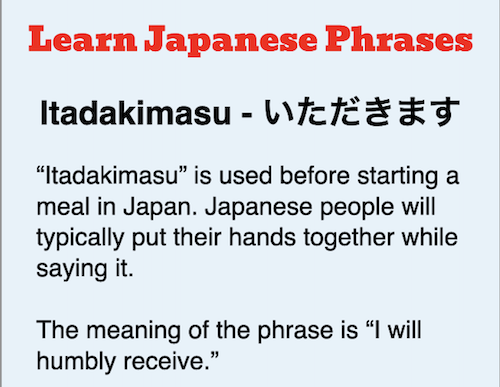
“Itadakimasu” is used before starting a meal in Japan.
Japanese people will typically put their hands together while saying it.
Listen to the Itadakimasu pronunciation audio below:
- ee-tada-kee-mas
- いただきます
About this phrase:
The meaning of the phrase is “I will humbly receive.”
“I humbly receive” may sound unnaturally polite in English, but…
This is why you can’t rely on translations alone to understand a language.
If you just look at the translation, you won’t get it. Or find it odd. The translation just cannot carry over the deeper meaning and culture behind it.
Hence why we need to explain it a bit more…
So, why do Japanese say itadakimasu BEFORE eating?
As mentioned before, showing respect and appreciation is deeply ingrained into the culture.
Japanese people are taught from a young age to finish the food on their plate and not leave leftovers.
Saying itadakimasu shows appreciation towards the food on many levels — appreciation for the ingredients, the farmers who have grown them, and the person who cooked the meal.
It is even customary to eat every grain of rice that is in a rice bowl.
The origin of this phrase can be traced back to Buddhism around the 6th century in Japan.
In Buddhism, everything including animals and nature are considered equal to people and respected.
By saying “Itadakimasu” you show gratitude and respect to the food that is about to be consumed.
Although it is a simple phrase, it is a great way to be mindful about eating and making sure to be present during the meal.
Gochisousama – ごちそうさま

You would say “gochisousama” after a meal.
Listen to the gochisousama pronunciation audio below:
- go-chi–sow-sama
- ごちそうさま
About this phrase:
This phrase shows appreciation and satisfaction for the food you ate.
Gochisou means “feast” in Japanese and sama is one of the most polite honorifics.
In English, it could be similar to saying “Thank you for the food”.
When they are combined, it has a profound respect towards the food and preparation.
Even when eating a simple meal the use of this phrase elevates the food and shows respect.
Within Japanese culture, it is also an important part of the etiquette to say this phrase.
It could be even considered rude or ungrateful to not say “gochisou sama” after eating.
There is also a profound sense of togetherness and community when everyone says this phrase at the end of the meal.
If you’re starting to learn Japanese it can be a great way to show some understanding towards Japanese culture to start using this phrase.
Example Sentences
Now, let’s look at some sentences with Itadakimasu and Gochisousama.
いただきます。
- Itadakimasu
- I humbly receive.
This is the basic form of the phrase that you should use before eating. Make sure to put your hands together and bow slightly when saying it. The phrase can be used in both formal and casual situations making it a versatile phrase.
お先にいただきます。
- Osaki ni itadakimasu.
- I’ll go ahead and start eating.
In Japanese culture, it can be rude to start eating before everyone else. Even if your food comes first at a restaurant you should wait for others to get their food. If you’re eating with close friends or family, or if others encourage you to eat first you can say this phrase to politely start eating.
お腹すいた。いただきます!
- Onakasuita. Itadakimasu.
- I’m hungry. I humbly receive.
This is a phrase you might hear from children who have been waiting for the food to be cooked and prepared. It is extremely casual so you should only say this when you are with friends and family. This phrase with itadakimasu can work perfectly when you have been hungry and haven’t eaten in a long time.
美味しそう。いただきます!
- Oishisou. Itadakimasu.
- That looks delicious. I humbly receive.
If you want to show a bit more appreciation than just the itadakimasu, you can also say that the food looks delicious! This is also a casual phrase so be sure to only use it with close friends and family. Anyone cooking and preparing the food will appreciate it if others think that it looks delicious.
ごちそうさまでした。
- Gochisousama deshita.
- Thank you for the meal.
In many polite situations, you will have to say gochisousama deshita instead of gochisousama. This phrase is a more polite version and can be used with acquaintances and even with friends to show an extra feeling of politeness. An example where you might use this is if you have been invited to someone’s house for dinner and you say this when you are also leaving the house. If someone has paid for your meal you can also say this phrase!
ごちそうさま。
- Gochisou sama.
- Thank you for the meal.
This is the more casual form of gochisousama deshita and you can use this phrase with close friends and family. Another example of when you should use it is when you eat at a restaurant and you want to show appreciation to the chef. Especially at smaller eateries such as ramen restaurants, you’ll see that many people will say this phrase as they leave.
美味しかった。ごちそうさま!
- Oishikatta. Gochisou sama!
- That was delicious. Thank you for the meal!
Just like when you are about to eat it can also be great to show some appreciation and compliments to the chef by saying that it was delicious. This is a more casual phrase so you should use it only when you’re with your friends and family.
とても美味しかったです。ごちそうさまでした。
- Totemo oishikatta desu. Gochisou sama deshita.
- That was delicious. Thank you for the meal.
This is a polite version of the previous phrase, and you can use it on formal occasions. For example, if your boss takes you out to dinner you could say this to show thanks for both the food and the boss for paying for the dinner.
Last Thoughts
When you’re learning a new language…
You often think you’re just translating yourself from English into say… Japanese.
And that culture is not necessary.
But words like itadakimasu and gochisousama are great examples of how language and culture are intertwined.
You can’t separate the two.
If you want to be a fluent speaker, you have to learn what’s natural in Japanese. And for example, saying “gochisousama” instead of “thank you” is the natural way.
And to understand what’s natural, you need to also understand culture.
Which can’t be translated into a simple word.
Leave a comment. I read ’em all.
– The Main Lingua Junkie
P.S. Remember: the more you expose yourself to the language, the better you get.
P.P.S. Interested in learning Japanese? This Japanese course for Absolute Beginners from JapanesePod101 is FREE for a limited time only. They plan to close it down in the future, but while it’s still open, give it a try. Click the image below.

Found this, very casually scrolling, happy I did, great stuff here